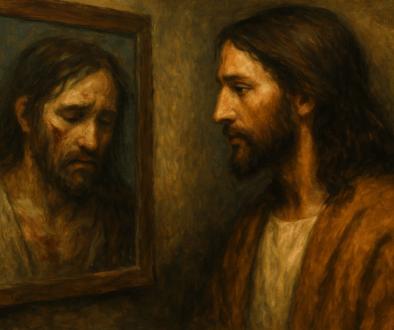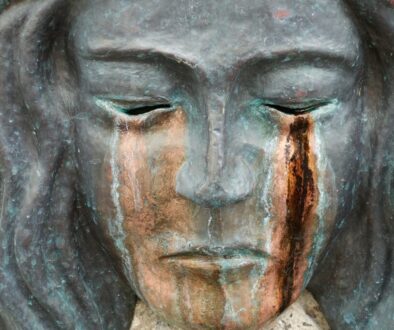

When the Ego Wears God: The Danger of Spiritual Bypass
Opening Scene: The Smile That Avoids the Wound
You sit in a church pew, heart quietly splintering. Maybe it’s the slow bruise of grief, or a chronic pain that has become your second skin. Maybe it’s the ache of loneliness—the kind that no one notices, but that hums beneath every hymn.
Someone catches your expression. They lean in, eyes kind, voice hushed:
“Just trust God,” they whisper. “He works all things for good.”
They mean well.
But you walk away lonelier than before—not because God failed you,
but because someone offered a phrase
when what you needed was a person to be there for you.
This is spiritual bypass.
And it may be one of the most common—and most misunderstood—traps along the road of faith.
What is Spiritual Bypass?
Coined by psychologist John Welwood in 1984, spiritual bypassing names a quiet betrayal: the use of sacred words, practices, and postures to sidestep pain rather than face it.
It is the smile that refuses to weep.
The theology that blames the sufferer.
The haloed image polished to hide the fracture beneath.
It wears the language of faith—but speaks it like a script.
It quotes Scripture to silence grief.
It confuses calm for healing, denial for peace.
But this isn’t a modern invention. Long before the phrase existed, the sages of every great tradition warned that piety can become a mask.
The ego, ever cunning, does not disappear when we discover God.
It simply finds new robes to wear.
Sometimes it kneels. Sometimes it sings.
And sometimes it recites verses to avoid being undone.
Bypass Is as Old as Religion — Four Ancient Warnings
Spiritual bypass is no modern mistake. Long before we named it, sages across traditions saw the danger: sacred forms without inner fire.
Buddha (Dhammapada 19):
One may recite the holy texts, but if he does not live them, he is like a herdsman counting another man’s cattle.
➝ The form is present. The life is not.
Bhagavad Gītā 3:6:
He who restrains his actions but still dwells on desires in his mind is a pretender.
➝ Self-control on the outside, chaos within.
Tao Te Ching 38:
When true virtue is lost, ritual appears. Ritual is the shell of true faith, brittle and empty.
➝ The sacred reduced to performance.
Pseudo-Chrysostom (5th c.):
To suppress righteous anger is itself a sin. Patience, when unreasonable, breeds more vice.
➝ Some peace is cowardice in disguise.
Together, they offer a chorus across time:
Without soul, religion becomes theatre.
Philosophers Who Unmasked Hollow Piety
Across the centuries, thinkers outside formal religion also warned that virtue-talk can mask ego-talk. Their insights dovetail with the sacred texts above:
- Socrates (Plato, Apology 29d-30a) — “Are you not ashamed that you give your utmost care to acquiring wealth, reputation and honour, and care nothing for wisdom, truth and the perfection of your soul?”
Takeaway: real transformation is soul-work, not social polish.
- Søren Kierkegaard (Attack upon ‘Christendom’, 1855) — “There is something frightful in the fact that the most dangerous thing of all—playing at Christianity—is never seen as dangerous.”
Takeaway: outward conformity can inoculate us against real inwardness.
These philosophical echoes remind us: when spirituality becomes performance, the ego is simply in disguise.
Spiritual bypass is no modern invention. From ancient scriptures to contemporary psychology, a single theme repeats: the outer form of religion often replaces the inner labor of transformation. Below are voices across time and tradition that unmask this age-old pattern.
Bible: Bypass Called Out
The Bible doesn’t silence pain—it names it. It even rebukes those who try to slap platitudes on it.
- Jeremiah 6 : 14 – “They have healed the wound of my people lightly, saying, ‘Peace, peace,’ when there is no peace.”
Why it matters: Toxic positivity in prophetic dress—leaders slap a slogan on a festering wound instead of treating the pain beneath. - Job 16 : 2 & 42 : 7 – Job groans, “Miserable comforters are you all,” and God later tells the friends, “You have not spoken of me what is right.”
Why it matters: Spiritual clichés (“You must have sinned”) blame the sufferer and spare the comforter from sitting with raw grief—so wrong that God himself rebukes it. - James 2 : 16 – “If one of you says, ‘Go in peace; be warmed and filled,’ yet you do not give them what is necessary for the body, what good is that?”
Why it matters: Pious talk without concrete help is exposed as useless—words that bypass action and leave real need unmet.
Five Faces of Modern Christian Bypass
- The Instagram Minimal-Saint
Look: Spotless white kitchen. Black coffee. Devotional reel with soft music.
Bypass tell: Poverty-chic aesthetics rack up likes while dodging hard questions—like consumer justice or quiet credit-card debt.
- The Spiritual CrossFitter (30-Day Fast Edition)
Look: Countdown graphics, daily streak updates, a heroic final weigh-in.
Bypass tell: Public discipline replaces private repentance; the fast becomes a flex, not a furnace.
- The Productivity Gospel Hustler
Look: 5 a.m. prayer selfies. Hustle-for-Heaven memes. Sermons on “10X your talent.”
Bypass tell: Exhaustion is sanctified. Sabbath becomes sloth. Lament is framed as a lack of vision.
- The Holy Fixer
Look: Runs prayer chains. Hosts crisis counseling. Never talks about his own addictions or crumbling marriage.
Bypass tell: “Carry one another’s burdens” (Gal 6:2) becomes a cover for control. He rescues to avoid himself.
- The Evangelism Addict
Look: Hands out tracts on every corner. Posts daily “repent!” reels. Avoids therapy like it’s sin.
Bypass tell: Converts others to dodge his own pain. Righteous rage shields a wounded house, still burning.
Why We Bypass — the short story
- From Stoics to Desert monks (3rd BCE – 4th CE). The Stoic ideal of apatheia—passion-free calm—seeps into early Christian asceticism. Cool detachment is rebranded as the summit of holiness, planting the first seed of “holy = unflappable.”
- Enlightenment reason meets the factory clock (18th–19th c.). Philosophers crown rational control as moral worth while the Industrial Revolution rewards steady, emotion-free productivity. The new sermon: think straight, work hard, don’t feel.
- Victorian fortitude & Muscular Christianity (late 19th c.). Empire and public-school ethics baptise the stiff upper lip. Tears are feminine, anger must be chivalric, and lament is unseemly. Emotional suppression becomes a badge of virtue.
- Positive-thinking & prosperity faith (1900s–1970s). From New Thought gurus to Norman Vincent Peale, cheerfulness is preached as the key to health and blessing. Sadness or doubt signals weak faith—precisely the logic of today’s toxic positivity.
- Brand-You in the algorithm age (1980s → now). Self-help hustle, curated Instagram grids, and “like”-driven platforms reward perpetual victory poses. Churches copy the optics to stay “relevant”; lament and righteous anger get shadow-banned.
Net effect: generations of “keep it together” conditioning have fused into a cultural reflex: to feel bad is to be bad.Spiritual bypass simply rides that reflex into church clothes.
⸻
Toxic Positivity & the Cost of Bypass — When Cheerfulness Chokes the Soul
Definition. Toxic positivity is the relentless insistence on positive thinking in every circumstance—an emotional “prosperity gospel” that declares any sadness, anger, or doubt a personal failure. It isn’t optimism itself that wounds, but the prohibition of anything else.
How it sounds:
- “Everything happens for a reason—smile!”
- “Good vibes only.”
- “If you speak negativity, you’ll attract it.”
How it harms:
- Invalidates pain – people feel unheard, leading to deeper isolation.
- Amplifies shame – sufferers decide their emotions are sinful or weak.
- Blocks resilience – research shows naming negative affect predicts quicker recovery; suppressing it predicts rumination and depression.¹
Data snapshot:
- Users exposed to “always-positive” social-media feeds reported higher envy and lower self-esteem than those seeing a balanced range of emotions (Bollen et al., 2021).²
- 22 % of U.S. adults frequently engage in spiritual bypass (Fox et al., 2017).
- Negative religious coping correlates with significantly higher depression and anxiety (Frontiers Psychiatry meta-analysis, 2023).
- Most churchgoers surveyed in Christianity Today (2024) received platitudes like “Just trust God” after loss—finding them unhelpful or hurtful.
A grieving mother put it starkly:
“I was told my baby died for a reason, that God needed another angel. I stopped going to church after that.”
Biblical antidote: Half the Psalms are laments; Jesus weeps at Lazarus’ tomb; Paul admits he “despaired of life itself” (2 Cor 1:8). Scripture normalises the full palette of emotion—joy and sorrow.
Bottom line: Toxic positivity is spiritual bypass in its most marketable form—a smile wide enough to hide any wound.
¹ Gross & John, 2003; Aldao et al., 2010.
² Bollen et al., Social Psychological Bulletin, 2021.
Shadow Work and the Bypassed Self
Carl Jung once wrote:
“Everyone carries a shadow, and the less it is embodied in the conscious life, the blacker and denser it is.”
Spiritual bypass is one of the shadow’s favorite hiding places.
It wears the mask of faith to avoid the mess of feeling.
It calls fear “discernment.”
It baptizes repression as “peace.”
We tuck our grief beneath theology.
We veil our fear with doctrine.
We silence our doubt through discipline.
As Lissa Rankin puts it:
“Spiritual bypassing is… to leapfrog the very trauma that most needs healing.”
But the parts we exile don’t disappear.
They ferment. They fracture. They find other ways to speak.
Until we face them, they sabotage connection.
But when brought into the light—named, felt, and welcomed—they begin to serve life.
Shadow work isn’t the opposite of faith.
It’s the faith to go deeper.
From Cosmetic Piety to Courageous Integration
So what’s the alternative?
It isn’t abandoning spirituality. It’s deepening it. Here are four shifts that mark the difference between bypass and true inner work:
- Lament over platitude. The Psalms rage, weep, and groan. Jesus weeps. Paul despaired of life. Faith includes sorrow.
- Embodiment over suppression. Feelings must be felt before they are healed. Jesus did not bypass Gethsemane.
- Integration over disowning. Shadow work invites us to face what we’ve denied: grief, anger, doubt, shame.
- Compassion over control. Healing comes through presence, not explanation. The wound opens to love, not logic.
Jesus and the Masks: Five Times He Refused to Bypass
Jesus didn’t just avoid spiritual bypassing—He exposed it. Over and over, He confronted the temptation to use religion as camouflage, to perform piety instead of embodying truth.
In the Sermon on the Mount, He warns: when you give, fast, or pray, do it in secret. Not to be seen. Not to earn applause. With quiet clarity, He dismantles virtue-signaling and calls for sincerity, knowing how easily devotion can become social currency.
He follows with the image of specks and logs: “First, take the log out of your own eye.” A call to self-reckoning. The impulse to critique others, He teaches, is often projection—an evasion of our own pain. This is bypass exposed: judgment without reflection.
In the Parable of the Good Samaritan, Jesus names another kind: compassion avoided in the name of purity. Religious leaders cross the road, stepping around suffering. It is the outsider who stops, who sees, who heals. Real faith doesn’t flinch from blood.
Then He enters the temple—and flips the tables. What looked like sacred business is revealed as exploitation. His anger is not sin—it’s sacred. Here, Jesus shows that silence in the face of injustice is also bypass. Decorum can be complicity.
And finally, to the Pharisees: “You are like whitewashed tombs—beautiful on the outside, but full of dead men’s bones.” Religion as costume. A gleaming surface hiding decay. Jesus doesn’t shame the broken—He exposes the polished and hollow.
Across these scenes, a pattern emerges:
Whenever spirituality becomes a mask, Jesus tears it off.
His love never flatters falsehood. His presence calls us into reality.
He doesn’t escape pain. He enters it. And He invites us to do the same.
Practices for Churches and Seekers
For Churches and Leaders:
- Teach lament as worship—not weakness.
- Model emotional honesty, from the pulpit to the prayer circle.
- Discern bypass language (“Just pray about it”) and gently redirect it toward presence.
- Normalize struggle as part of the path—not a failure of faith.
For Individuals and Seekers:
- Honour anger when it signals injustice or unhealed pain.
- Explore the shadow through journaling, therapy, or wise companionship.
- Practice embodiment—stay with emotions as they arise in the body.
- Seek spiritual spaces where truth is welcome, not just performance.
Conclusion: The God Who Does Not Bypass
To follow Christ is not to escape pain through religion. It is to walk into it, eyes open, heart honest, shadow embraced. It is to refuse the cosmetic mask. And to let truth, no matter how raw, be the place where God meets us.
If this resonated with you, consider journaling your own moments of bypass—and what it would mean to face them differently. Or share this post with someone walking through their own unbypassed pain.