The Prodigal Within: Healing the Wild and the Righteous
The Prodigal Son as You’ve Never Seen Him: A Psychological Reading of Luke 15
This post approaches Jesus’ parable of the Prodigal Son not only as a tale of moral repentance but as a mirror of inner transformation. Drawing on Jungian depth psychology, Internal Family Systems (IFS), and contemplative Christianity, we will follow the story as a map that leads from fragmentation to feast.
Layered Truth
Jesus told stories with layers —
moral, spiritual, psychological;
and if you listen closely,
mythic, relational, even social.
The Prodigal Son is more than a family drama.
It dramatizes every soul’s split between duty and desire,
rebellion and respectability,
the wild child and the rule-keeper.
Yet, with breathtaking compassion, the parable points to a third presence:
the One who can hold both halves,
the inner center,
the Self.
1 The Split: Two Sons, One Psyche
The scene opens with rupture.
“The younger one said to his father, ‘Father, give me my share of the estate.’ So he divided his property between them.” – Luke 15:12 (NIV)
A younger son demands his inheritance — sheer impulse.
His older brother stays home — dutiful persona.
In the ancient Near East, asking for an early inheritance was tantamount to wishing your father dead — a staggering breach of honor.
Depth psychology hears a divided self:
- Instinct vs. approval
- Eros vs. logos
The younger son embodies what we repress — desire, creativity, hunger.
“He wasted it all on wild living.” – Luke 15:13 (NIV)
Jung would place him in the shadow, the raw material of the personality we disown.
IFS calls him an exile.
“We all have a ‘wild man’ or ‘wild woman’ within.
They must not be repressed but honored, seen, and integrated.”
— Clarissa Pinkola Estés
The elder son mirrors the internalized parent — moral manager, achiever, our social mask.
He is today’s perfectionist employee, the one who never breaks a rule.
Neither sibling is wrong; both are incomplete.
2 Descent: Banking on Freedom, Meeting Pigsties
Fleeing structure, the younger son spirals: fortune lost, famine, pigs.
“He would have been glad to eat what the pigs were eating, but no one gave him a thing.” – Luke 5:16 (CEV)
Alchemical writers named this plunge nigredo — “the blackening.”
Mystics call it the dark night; recovery circles, rock bottom.
It is soul-starvation: the moment the false self collapses and every external fix proves too thin for the ache within.
“He came to himself.” – Luke 15:17 (NIV)
Not guilt, not shame, but awakening.
3 The Father: The Self Awaits
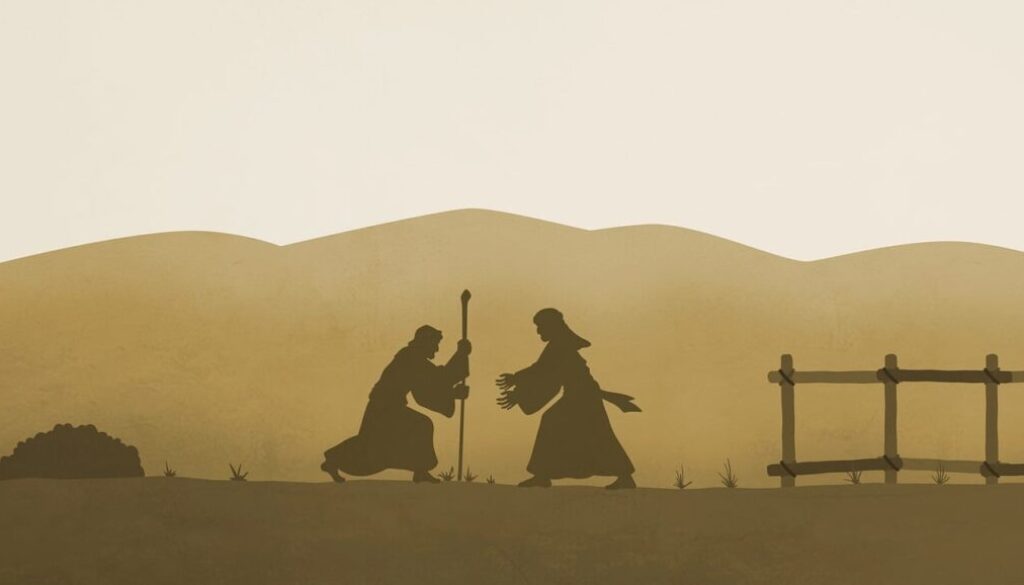
The father doesn’t scold; he runs.
“While he was still a long way off, his father saw him and was moved with compassion. His father ran to him, hugged him, and kissed him.” – Luke 15:20 (CEB)
He is God — the Father — and, psychologically, the Self: the inner echo of divine wholeness that welcomes us before we are fixed.
- Therapists call him an earned secure base — felt safety that even the wounded can learn.
- Contemplatives, the still point.
- Jung, the Self, “center and circumference” of the whole psyche.
Restoration follows:
“‘Quickly, bring out the best robe and put it on him! Put a ring on his finger and sandals on his feet!’” – Luke 15:22 (CEB)
- Robe — dignity reclaimed.
- Ring — belonging and authority restored.
- Sandals — grounding for a new walk.
This is not about being “good again.”
It is about being whole again.
4 The Elder Brother: The Counter-Shadow
Wholeness requires more than return; it demands reconciliation.
“The shadow is not a problem to solve; it is a mystery to face.”
— James Hollis
The elder hears music and refuses the feast.
“The older son was angry and would not go in to the party.” – Luke 15:28 (ERV)
He is the counter-shadow — darkness hidden in virtue, a shadow dressed in white.
IFS names him a manager: a strict protector who keeps us compliant yet disconnected.
The father pleads with him, too.
Integration is not choosing sides; it is holding tension.
The feast is incomplete until both are inside.
(Modern parallel: many churches, families, and workplaces idolize the “older sons” — high achievers and loyal rule-keepers — while shaming or exiling their “younger” counterparts. Both parts need welcome.)
5 The Feminine Absence: The Missing Mother
A curious silence: no mother, no nurturer.
Jungians call this missing anima, the inner feminine.
Without her, tenderness yields to duty; connection hardens into performance.
In this story the father must carry both parental energies, just as the Self holds justice and mercy.
But here it is:
God is not only masculine; the divine is total — strength and softness, form and flow, Father and Mother.
The Father in this story is both nurturing and structural.
6 Integration: The Real Homecoming
The story ends open-ended: younger inside, elder outside, Father waiting at the threshold.
Here the parable becomes your own:
“Wholeness is not achieved by cutting off a part of oneself, but by integration of the contraries.”
— C. G. Jung
Both siblings live in you: the impulsive dreamer and the responsible critic, exile and manager.
Individuation is reunion — weaving them into a self that can rest.
The wildness needs structure; structure needs heart.
The divine Self already embodies both: justice and mercy, fire and embrace, Logos and Eros.
The true homecoming is not a place but a union of instincts and ideals, freedom and responsibility.
The feast begins when every part comes to the table.
“Your brother was dead, and is alive; he was lost, and is found.” – Luke 15:32 (ESV)
That is integration; that is grace.
The Father’s house isn’t just heaven.
It is wholeness.
Practice 🌿 Dialogue Between Parts
- Imagine the younger and elder siblings as voices within you; let the Father speak too.
- Ask each voice: What do you need? What do you fear? What would healing look like?
- Reflect:
- Which sibling feels closest right now—and why?
- How does your inner elder sibling try to protect you?
- Can you picture a Father who holds space for both?
Wholeness isn’t silencing either voice; it is building a house spacious enough for both.
That is where the feast begins.