The Pharisee, the Tax Collector, and the Art of Shadow Work
Few of Jesus’ stories reach so quietly and cut so deeply. The parable of the Pharisee and the tax collector (Luke 18:9–14) is short enough to miss—but it holds an entire universe of inner transformation. Beneath its surface lies a subtle, haunting invitation: lay down your perfection, speak plainly to the silence, and be unmade by mercy.
This is not just a warning against pride. It is a map. A holy doorway into the work of turning inward—to face what we’ve hidden, exiled, or buried beneath performance.
Two Prayers in the Temple
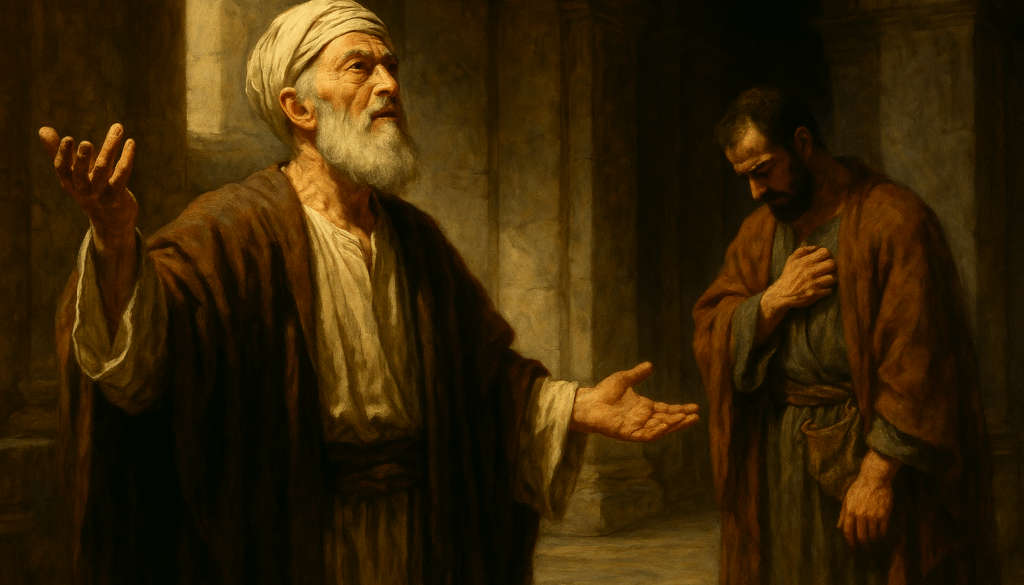
Two men climb the steps, one cloaked in certainty, the other in silence. The Pharisee lifts his face, his voice, his moral résumé. He fasts, he tithes, he thanks God he is not like the broken ones. But there is no ache in his voice, no fracture. Only a polished mask that refuses to crack.
The tax collector? He stands apart. Far from the altar. Far from the crowd. He does not look up. He beats his chest. His prayer is barely a sentence:
“God, have mercy on me, a sinner.”
No arguments. No performances. Just the tremble of a man whose soul has run out of hiding places.
Why Their Roles Matter
This parable doesn’t just contrast two attitudes. It contrasts two archetypes — and Jesus chooses them with precision.
The Pharisee was the religious elite — a model of moral discipline, admired for his outward righteousness. He represents the persona — the curated self we polish for others to see, and sometimes even for God to see. His goodness becomes a performance. His virtue becomes armor. He prays, but his prayer is a résumé, not a surrender.
The tax collector, by contrast, was a social and spiritual outcast — hated for his role as a collaborator with Rome, seen as corrupt, unclean, unworthy. He stands for the shadowed self — the rejected, the shamed, the parts of us we exile. And yet, it is this man who comes with nothing but need. His mask is already off. His shame is already visible. And from that honest place, his prayer becomes real.
This contrast is not accidental. It is the entire point.
Jesus places these figures in the temple not just to teach about humility, but to show us the shape of the soul’s healing. The exalted man cannot be touched — he is defended. The broken man is ready to be held — he is already low.
The Pharisee clings to the light to avoid his darkness. The tax collector walks through the darkness and finds the light waiting there.
The One Who Was Made Right
And then the reversal—the kind Jesus always slips in like a blade between the ribs.
The one who wept walks away whole. The one who boasted walks away the same.
The temple did not change. But one man let himself be changed.
This is the paradox of spiritual life. The more we exalt ourselves—through image, intellect, activism, or religion—the further we drift from the marrow of grace. The more we humble ourselves—not perform humility, but descend honestly into it—the more we find the kind of rising that can only come from God.
The Descent Into the Soul
The work of facing the hidden self is not a trend. It is a reckoning. A remembering. A sacred descent into the soul—the valley path where masks fall and mercy rises.
When you notice yourself judging another, pause. That flash of contempt is often a mirror turned outward.
When you find yourself performing goodness, pause again. What might you be hiding beneath that light?
Let your body tell the truth. Kneel. Bow your head. Place a hand on your chest. Not as ritual, but as recognition: *I am not above the broken. I am one of them.*
Speak your ache. Even if your voice shakes. Especially then.
Ask for mercy. Not as punishment, but as permission—to begin again without needing to be anyone else.
This is not mere self-awareness. This is soul excavation. Letting grace touch the wound. Naming the exile and welcoming them home. Becoming real, despite the cost.
The Inner Temple
Inside you, there is a sanctuary. And within it, both men live. One stands tall, rehearsing his virtues. The other stays low, whispering his need.
Every time you come to prayer, to silence, to stillness, the question is not: are you worthy? The question is: are you willing to be real?
The way up is always down. The doorway to joy is cracked open by grief. And the soul is never more luminous than when it finally drops the mask and lets itself be held.
So let go. Speak low. Be found.
Begin again. And again.