
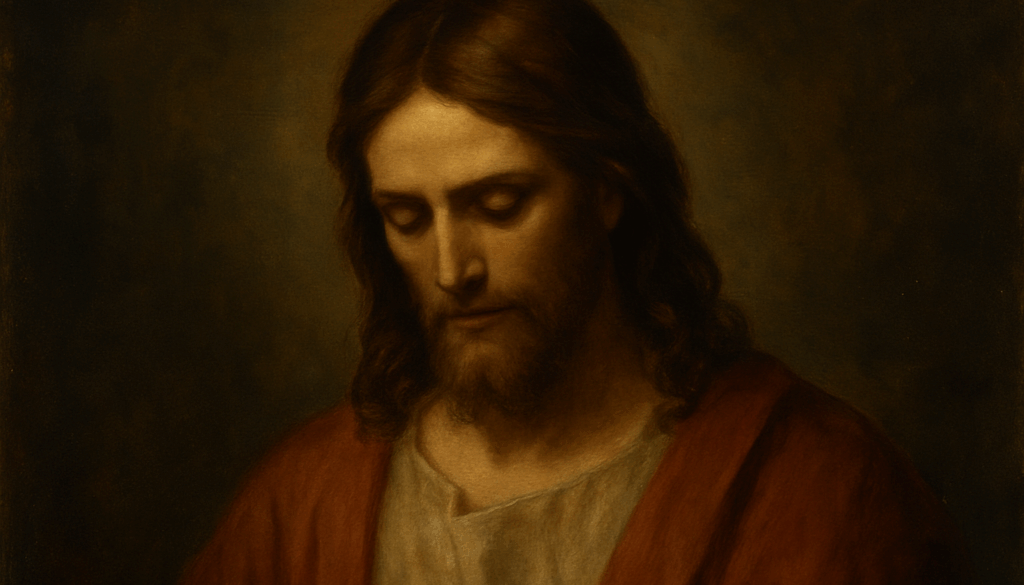
The Inner Christ: A Psychological and Spiritual Phenomenon
Did Jesus exist? Does he now?
Is he God? Was he a man?
One idea keeps coming back to me:
“Christ lives in me.” — Galatians 2:20
“Christ in you, the hope of glory.” — Colossians 1:27
It seems too powerful a phrase to mean merely acting like Christ.
And yet it often gets watered down — in doctrine, in moralism, in abstraction.
Charles Ellicott, a respected 19th-century Anglican bishop, wrote:
“Consciousness, rigorously examined, tells us that even in the most exalted souls there is no such thing as an actual union of the human and divine.”
He wrestled with the mystery — but ultimately concluded:
“This idea, when pressed to precise logical definition, must necessarily contain a certain element of metaphor.”
Turned into metaphor.
Tamed.
Made safe.
Because anything mystical seems… dangerous.
For many, Christ in you gets reduced — to metaphor, to moral inspiration, to religious language.
Some go even further.
As John MacArthur warns:
“Mysticism is a system of belief that attempts to perceive spiritual reality apart from objective, verifiable facts… Spontaneous feeling becomes more significant than objective fact.”
But isn’t that exactly what Paul meant by gnosis?
Not doctrine.
Experience.
Not belief alone — but union.
“Christ lives in me” becomes
“Try to be a good person.”
Or worse:
“Pretend to be someone you’re not — until you die.”
But that’s not what Paul meant.
Not even close.
A Living Theology
It’s a wild thought —
Too alive, maybe,
for tame, modern disciples
just trying to behave.
Have you ever really sat with it?
Christ in you.
And felt —
No, he isn’t.
I don’t feel him there.
And then you just… go on.
Keep doing the Christian life.
All the while sensing:
There’s something in this —
and I don’t have it.
Others smile and behave
like they’ve got it.
Maybe they do.
Maybe they don’t.
Who’s to say?
And what even counts as knowing?
If subjective experience means anything —
and isn’t everything else just interpretation?
What’s objective, anyway?
“Verifiable facts,” they say.
But who decides what counts as verifiable?
According to Scripture, the highest form of knowing
isn’t information —
it’s gnosis.
The John 17:3 kind.
Intimate.
Experiential.
Relational.
The Greek word used is ginṓskō —
“To know through personal experience; firsthand acquaintance.”
(HELPS Word-studies, Strong’s 1097)
So maybe there’s something more.
Not just knowing about Christ —
but knowing Christ.
Not imitation —
but indwelling.
And it’s telling that Paul —
a Pharisee, trained in law and logic —
when grasping for words to describe the experience,
doesn’t offer a theory.
He says simply:
“Christ in you.”
The Ache for Something Real
So what’s it all about?
Do we just let the idea fade —
tell ourselves it was poetry, metaphor, symbol?
While hoping that CBT,
and the busy work of modern life,
will somehow bring the change
we still ache for inside?
—
Christ in you?
Like a little Jesus operating your brain?
Like trying really hard to act like him?
Or just some vague sense of peace?
MacLaren once wrote:
“His abiding in us does not destroy but heightens our individuality.
We then most truly live when we can say,
‘Not I, but Christ liveth in me’;
the soul of my soul and the self of myself.”
But how can another being inside you heighten your individuality?
How can Christ be “the soul of my soul and the self of myself”?
What really is this?
We keep naming it,
quoting it,
singing about it…
but rarely feeling it.
And when we dare to sit with it,
the thought almost pushes us toward madness.
Too vast.
Too intimate.
Too alive to fit neatly in a sermon.
But then again —
maybe some people do feel it.
Maybe they smile because they know.
Maybe not.
How would you even tell?
I believe it’s a deeply personal thing.
That’s gnosis.
Not information,
but transformation.
And here’s the thing:
Scripture doesn’t present this as metaphor.
Not as a goal.
But as something that happens.
“Christ lives in me.”
— Galatians 2:20
That’s not poetry.
That’s testimony.
It’s a phenomenon —
(phainomenon, Greek: “that which appears.”)
In philosophy: a subjective experience that arises in awareness.
But in this case, it doesn’t just appear to you.
It happens in you.
Quietly.
Fully.
Undeniably.
You don’t manufacture it.
You don’t control it.
You don’t pretend it’s there.
It just… is.
And when it happens —
you don’t miss it.
The Psyche Meets the Sacred
This is why I love psychology.
It looks at this from different angles.
Jung saw Christ not merely as a man in history,
but as the central archetype of the Self —
a living inner presence guiding us toward wholeness and integration.
Think of Jesus as the healer, the liberator, the teacher,
the miracle worker, the friend of outcasts,
the resurrected one, the divine representative on earth —
operating within you.
That’s what Jung saw:
Not just a person,
but a pattern in the soul.
Christ as the image of the fully integrated self,
(it echos “the self of myself” doesn’t it!)
where the divine and human are no longer at war.
Abraham Maslow, known for the Hierarchy of Needs,
eventually placed something above self-actualization:
self-transcendence.
A deep human longing —
to go beyond the ego,
to merge with something deeper, higher, more whole.
Not to escape the self —
but to fulfill it.
Doesn’t that echo Paul’s words?
“It is no longer I who live, but Christ lives in me.”
Transcending the “I” —
not through loss of identity,
but through the arrival of a truer one.
And then there’s Spiritual Emergence,
a transpersonal psychology framework developed by Stanislav and Christina Grof.
It describes what happens when someone begins to experience
a presence or energy greater than themselves —
a deeper self, a higher reality.
In other words:
Christ within.
Sometimes it comes gently.
Sometimes, it overwhelms.
And when the ego can’t hold it —
it becomes a spiritual emergency —
a full-blown identity crisis.
And doesn’t that sound like Paul?
“It is no longer I who live…”
The ego collapses.
Something else awakens.
Not theory.
Phenomenon.
Rebirth.
Evidence, Mystery, and the Inner Life
I’m not saying these models are perfect.
But they’re not just speculation.
They’re serious, evidence-based attempts
to explore the deeper dimensions of human life.
They may not come through logic —
but that doesn’t make them invalid.
Mainstream psychiatry often dismisses what it can’t quantify.
But if you believe the Bible —
or even just take the Christian life seriously —
you already know:
There’s more to being human than reason alone.
To reduce everything to rationalism
is to miss the mystery.
And mystery is where transformation lives.
As long as you keep trying to explain Christ in you,
you may resist ever experiencing it.
Christ Within
If both the Bible and psychology are open to the idea
of something higher dwelling within you —
then maybe it’s time we took that seriously.
Yes, fundamentalists and Enlightenment thinkers
have tried to reduce what they can’t measure —
to dismiss it, control it, call it dangerous.
And maybe it is dangerous.
But only because it’s powerful.
Don’t let modernity strip you of this experience.
Don’t settle for metaphor
when transformation is on offer.
The evidence is there.
The hunger is real.
And maybe — just maybe —
Christ is waiting.
Inside.