The Great Banquet Parable Explained: Ego, Wholeness, and the Invitation of Grace
Luke 14:15–24 — The Parable of the Great Banquet
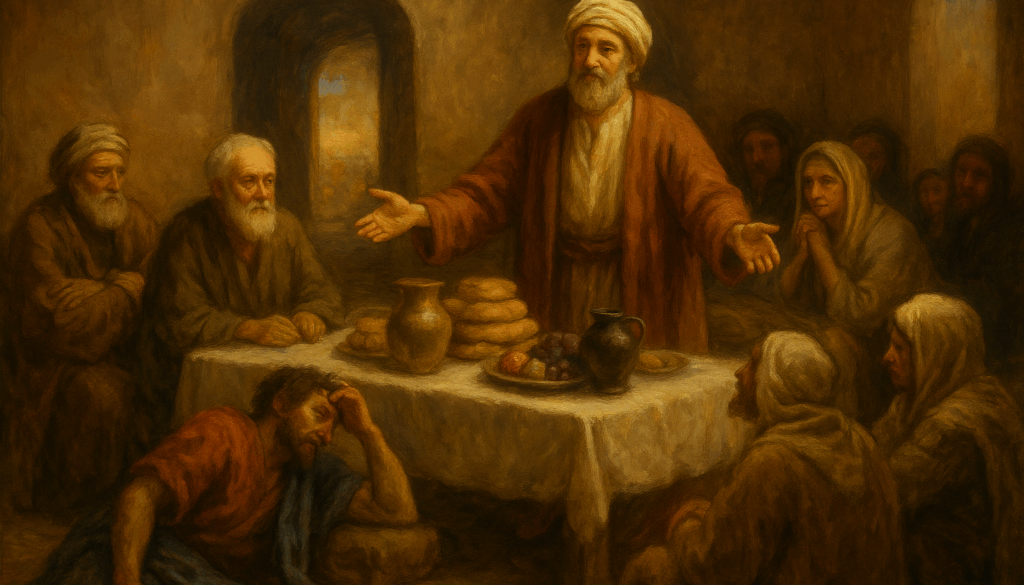
A man prepares a great feast. Everything is ready.
The invitation is sent.
And no one comes.
One has a field to inspect. Another is testing new oxen. A third just got married.
So the host sends his servant to the streets and alleys, the roads and country lanes.
“‘Go out quickly into the streets and alleys of the town and bring in the poor, the crippled, the blind and the lame.’” — Luke 15:21
Those originally invited miss the meal.
But the broken, the rejected, the unclean—the ones no one expected—are gathered into the feast.
The Psyche Beneath the Parable
On the surface, this is a story about who shows up—and who doesn’t.
But beneath it lies a drama playing out in every soul:
the tension between our ego-constructed life and the deeper Self’s invitation to joy.
The ego is the part of you that tries to manage life through control, image, and effort.
It’s not bad—it’s just limited. It builds a world to survive,
but it cannot access the joy of simply being.
So when grace calls, the ego hesitates.
It doesn’t know how to receive.
This is why happiness always feels just out of reach—
why striving, achieving, and accumulating never quite satisfy.
“We unconsciously feel that there is something greater to which we long to belong.”
—Toko-pa Turner, Belonging: Remembering Ourselves Home
That “something greater” is the banquet.
The kingdom of wholeness.
Union with the divine.
A table set with unconditional welcome—for every part of us.
And yet, most of us say no.
Not with our mouths, but with our lives:
Too busy.
Too self-sufficient.
Too defended to simply receive.
The Paradox of Happiness
This parable names the deep ache at the heart of modern life:
We want to be happy—but we cannot get there by trying.
“Ask yourself whether you are happy, and you cease to be so.” — John Stuart Mill, from Autobiography (1873)
The ego’s effort to pursue happiness is the very thing that prevents it. It chases, controls, schedules, performs.
But the banquet cannot be earned. It must be received.
Joy arrives when the striving part of you finally stops striving. When you stop outsourcing your worth. When the parts of you long hidden—ashamed, unseen, tender—are welcomed in.
This is why the door to the kingdom is always open…
but rarely entered.
The Refusal of the Call
The initial guests reflect what Joseph Campbell calls the Refusal of the Call.
The banquet is ready—symbol of divine presence, sacred joy, the “elixir” at the end of every myth.
But ego-bound characters cannot hear it.
They are locked into external achievements, possessions, and roles: field, oxen, spouse.
“The refusal of the summons converts the adventure into its negative. Walled in boredom, hard work, or ‘culture,’ the subject loses the power of significant affirmative action and becomes a victim to be saved.”
—Joseph Campbell
In other words: When we ignore the soul’s invitation—when we say “I’m too busy, too tired, too responsible”—we don’t stay neutral.
We drift.
Life becomes flat, performative, or compulsive.
We lose touch with meaning.
We may look successful, but inwardly we’re starving.
The banquet is ready, but we’re still out in the fields, proving ourselves.
Individuation Through the Feast
The housemaster sends his servant into the unconscious: the streets and alleys.
There, the rejected figures wait: the poor, the crippled, the blind, the lame.
These are not just outcasts—they are the shadow.
“To honor and accept one’s own shadow is a profound spiritual discipline.”
—Robert A. Johnson, Owning Your Own Shadow
Jungian psychology teaches that to become whole (individuation), we must welcome these rejected aspects.
The feast becomes a temenos—a sacred container—where opposites unite.
Not by force, but by invitation.
Wholeness is not perfection. It is inclusion.
All Parts Welcome at the Table
“All the misfits and homeless and down-and-out you can lay your hands on…”—Luke 14:21 (MSG)
From an Internal Family Systems (IFS) lens, the banquet is a drama of parts:
- The original invitees are Manager parts—field-buyers, ox-testers, newlyweds—those trying to earn worth through control, success, or relationships.
- The guests from the streets are Exiles—hidden, wounded aspects of the self, burdened with shame.
- The host images the Self—calm, spacious, unshaken by rejection, ready to receive all parts with compassion.
“All parts are welcome. All parts are valuable. There are no bad parts.”
—Richard C. Schwartz, founder of Internal Family Systems
Healing occurs not by scolding the Managers, but by letting the Self lead.
By making room for what was once cast out.
The Banquet as Being
“I want my house full!”—Luke 14:23 (MSG)
The feast is a moment of nowness—of being.
To enter it, you must stop striving, proving, achieving.
You must be willing to be seen.
“The soul always knows what to do to heal itself. The challenge is to silence the mind.”
—Caroline Myss
That is why the ego resists.
It knows it cannot control this kind of feast.
But your soul longs for it.
Why the Ego Won’t Come
In myth and psychology alike, the ego is not evil—but it is limited.
“Then they all began to beg off, one after another making excuses.” — Luke 14:18 (MSG)
It constructs a world to survive. It gains power, reputation, control.
But when the deeper invitation comes—“Everything is ready. Come.”—the ego says, “I’m busy.”
Why?
Because the feast is free.
And the ego does not know how to receive.
A hamster in a wheel it doesn’t know how to get off.
“The ego’s greatest fear is not death, but surrender.”
—Michael Singer
It fears surrender.
It cannot grasp grace.
The original guests are not punished.
They simply miss it.
They stay outside—still managing land, animals, relationships.
They are not condemned, just…absent.
The invitation doesn’t cease.
It simply moves to where there’s hunger.
In their place, the broken arrive.
The soul’s exiles come home.
The house is filled.
What This Means for You
Every day, the invitation goes out.
Not to try harder.
Not to be better.
But to come.
To the table.
“Wholeness is not achieved by cutting off a portion of one’s being, but by integration of the contraries.”
—C.G. Jung
To the place inside you that welcomes every part of you.
Even the ones that feel unworthy.
Even the ones the ego pushed aside.
This is the kingdom.
This is the banquet.
And this is how the soul begins to heal:
Let the managers rest.
Let the exiles speak.
Let the Self open the door.
Reflection Practice
- What excuses do your inner Manager parts make when grace calls?
- Can you name the parts of yourself that feel too broken to belong?
- How might you “compel them to come in” with love?
Wholeness doesn’t look like perfection.
It looks like a full house.
You are invited.