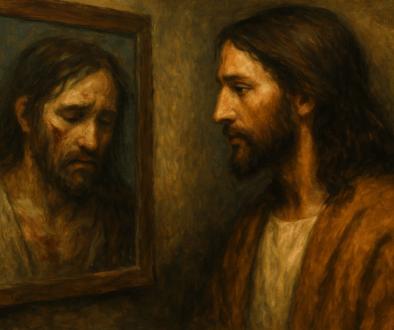

From Guilt to Grace: Exploring the Transformative Psychology Behind Christ’s Ransom
How Christ’s ransom heals guilt, shame, and the divided self: A complete guide.
“It is a very deep ache that something is not right—something is crooked, out of place, or missing altogether. It is the feeling that makes me breathe shallow and writhe deeply—a relentless focus on a whole that has been cut and left unfulfilled.”
—Old Journal Entry
What is it that makes me feel guilty just by existing? Sure, I’ve made mistakes—acted foolishly, gone against my own best interests, perhaps even against God’s will. Yet, it seems that no matter what I do, no matter how much of the Bible I read, how deeply I meditate, or how many self-help books I consume, that nagging sensation remains: I’m not who I should be.
“All have sinned and fall short of the glory of God.”
—Romans 3:23 (NIV)
These days, that feeling is more manageable. But for years, I was chasing an impossible ideal without the tools to reach it. The result? Relentless self-criticism—a harsh, unrelenting voice in my psyche. I carried guilt without knowing why.
🙏 Why Morality Isn’t Enough: The Pull Beneath the Fall
Most people — Christian or not — agree that doing good is a good thing.
📖 “Do not be overcome by evil, but overcome evil with good.” — Romans 12:21 (ESV)
Amen. We get it. Our minds know this.
We don’t sin because we think evil is better.
So we try to be good — as good as we can.
But eventually, morality feels hollow.
Or something deeper pulls us back into the same old patterns.
Why do we relapse — again and again — into what we consciously reject?
If something inside you senses that morality alone can’t heal the soul — explore more here.
👉 [Read the post]
🎯 The Ache Beneath Our Morality
“I do not do what I want, but I do the very thing I hate.” — Romans 7:15
The problem isn’t ignorance — it’s fragmentation.
🏹 We Miss the Mark Because We’re Alienated from the Mark
The Bible’s word for sin is hamartia — an archery term.
It means: to miss the mark.
But what if the problem isn’t just poor aim?
Maybe the problem isn’t just that we’re bad shots — but that we’ve lost sight of the target altogether.
As if we’re holding a bow in a fog, unsure which way the range even lies.
Maybe we can’t even remember what the target looked like —
or whether it ever existed at all.
We are not just morally weak — we are spiritually cut off.
“And you, who once were alienated and hostile in mind, doing evil deeds…”— Colossians 1:21
Alienation isn’t the result of sin. It’s the root of it.
We are estranged from God.
Estranged from the Source.
Estranged even from the part of ourselves that wants the good.
This isn’t just failure — it’s fracture.
And no amount of moral striving can reconnect what only grace can restore.
👉 Read the post: The Dangers of the Ideal — When Noble Aspirations Eclipse the Divine
💔 Not Just What You Did — But What You Couldn’t Become
Many Christians (and non Christians) wrestle with moral guilt — the sorrow of having done something wrong.
But underneath that lies a deeper grief.
It’s not only “I sinned.”
It’s “I fell short of myself.”
This is what Martin Heidegger, in Being and Time (1927), calls existential guilt (Schuld):
not the guilt of violating a rule, but the ontological weight of being finite, fragile, and full of unrealised possibility.
Philosopher Michael Sugrue captures it:
“Guilt is the uncomfortable certainty that we are not what we could have been.”
That line struck me like revelation.
I wasn’t crushed by what I had done…
but by what I hadn’t:
-
The roads I never walked.
-
The selves I never became.
“He has also set eternity in the human heart…” —Ecclesiastes 3:11
We carry a longing for the infinite, yet we bleed the possible.
Every choice leaves countless alternatives unrealised, and somewhere deep inside we feel the loss.
🕳️ Alienation, Guilt, and the Lost Self
Across philosophy, psychotherapy, and theology, the same ache surfaces:
We are not what we could have been.
We are not who we are.
We are not where we belong.
🔹 Heidegger, in Being and Time, calls it fallenness —
a state where we’re absorbed by the noise of the world, exiled from authenticity,
running from the truth of our limits.
“In anxiety, one feels oneself brought back from the ‘they’ to oneself.”
🔹 Yalom calls it existential guilt —
a sorrow not for what we’ve done,
but for the unlived life we buried.
“The impossibility of fulfilling all of one’s innate potentialities.”
🔹 Tillich calls it estrangement —
a rupture not just within, but from Being itself.
“Man is estranged from the ground of his being.”
This is not just emotional pain.
It is spiritual dislocation.
Not just doing wrong — but being unmoored.
Not just guilt — but metaphysical homelessness.
Not just failure — but fracture at the root.
This is the ache no amount of morality can mend.
This is the wound that doctrine alone cannot reach.
And it brings us here —
to the edge of our strategies,
to the end of self-improvement,
to the raw, honest cry beneath it all:
Is there a way back?
👁️ If you want to go deeper into this ache — not just as an idea, but as something felt — this piece sits with it fully. It’s not about fixing. It’s about facing.
👉 [The Truth We Run From, the God We Can’t See]
Jesus: the Answer…Really?
“‘Jesus is the answer’ is the latest cliché to elicit glares, groans, eye-rolling, and witticisms in our house…”—Theresa Latini, Reformed Journal
Jesus is the most quoted, misquoted, adored, and ignored man in history.
And yet we’re told that this obscure, enigmatic figure—from a dusty corner of a long-collapsed empire—holds the key to our most modern ache: existential guilt.
Really?
The Bible, whether you read it or not, speaks it plainly:
“For there is one God and one mediator between God and mankind, the man Christ Jesus, who gave himself as a ransom for all people.”— 1 Timothy 2:5–6 (NIV)
One God — Being, Source, the horizon of our deepest longing.
One mediator — not a system, not a philosophy, not an escape, but a man.
Kierkegaard called this the ultimate paradox:
“Christ is the Paradox, the God-man. He is the very compounding of God and a socially insignificant man… the sign of offence and the object of faith.”
According to Scripture, He was fully human and fully divine.
He walked both realms—the finite and the infinite—fusing dust and divinity in one body.
And yet, that is our condition too:
Made from dust, yet bearing the image of God.
Fallen, yet haunted by glory.
Finite, yet aching for the infinite.
Jesus isn’t just a religious figure—He is a living symbol, echoing something ancient in the soul.
Carl Jung, the father of analytical psychology, saw in Christ the embodiment of totality:
The union of opposites. The call to wholeness.
“Christ exemplifies the archetype of the Self.”— Carl Jung, Aion (CW 9ii, p. 36)
By Self, Jung didn’t mean the ego—the anxious, narrow self we defend.
He meant the full human psyche—integrated, reconciled, whole.
The place where dust and divinity meet.
The Self is not perfection—it is union.
And in Christ, Jung saw that union made flesh:
The eternal wrapped in skin.
The holy bearing wounds.
The infinite entering time.
In Him, the finite stretches toward the infinite.
The broken is not discarded—but made whole.
The rejected is not erased—but redeemed.
Jesus holds the unbearable tension of our condition—
dust and divinity, sorrow and radiance—
not as escape, but as transformation.
He is not just the answer to our pain.
He is the shape our ache has always been taking.
We are the question He completes.
He is the symbol of the human condition—
the suffering, the surrender, the hope.
He is the finite touching the infinite.
The archetype of healing through descent.
He doesn’t offer an escape from pain—He embodies it.
To say “Jesus is the answer” isn’t just a cliché.
It’s a dare.
A dare to face the full weight of our guilt, our grief, our longing—
and to believe that somehow, that weight can be held.
He is not just a figure in history.
He is the human story, told to its end.
Jesus’ Death, Ransom, and Grace in the Face of Existential Guilt
Jesus confronted guilt and human limitation head-on.
According to Scripture, He was sinless—free from the fracture we carry within.
Yet He stepped directly into our condition.
Not from a distance.
Not to shame us.
But to bear it.
“He who did not spare His own Son, but gave Him up for us all…” —Romans 8:32 (NIV)
This is where the mystery deepens.
The one who knew no guilt takes on guilt.
The blameless one enters our blame.
The whole one embraces our fracture.
Through His death, Jesus doesn’t merely atone for sin—He enters into the very core of human experience: regret, shame, fear, lost potential, and the painful weight of freedom. He meets us not only as Redeemer, but as mirror.
In what follows, we’ll explore how His death and grace speak to some of the deepest struggles of the human soul:
Living in the Present
“Therefore do not worry about tomorrow, for tomorrow will worry about itself. Each day has enough trouble of its own.”—Matthew 6:34 (NIV)
Existential guilt is the ache of holding infinity within finite selves—
the painful tension of limitless potential constrained by human limitation.
It creates inner turmoil, a restless longing that makes it nearly impossible to fully inhabit the now.
But Jesus’ gift cuts through this torment.
He frees us from regrets about the past
and fear over what may come—
anchoring us in the only place we can ever truly live:
the present moment.
“Life is now. There was never a time when your life was not now, nor will there ever be.”—Eckhart Tolle, The Power of Now
Here, in the now, His grace whispers:
Don’t dwell on the what ifs,
the could-have-beens,
the might-bes.
“Now is the time of God’s favor, now is the day of salvation.”—2 Corinthians 6:2 (NIV)
They are ghosts. Illusions.
The present is the only real ground where the soul can breathe.
And so, existential guilt—this subtle resistance to being here—
melts in the light of Jesus’ death.
His sacrifice is a wake-up call:
Guilt about existence is an illusion.
Nothing else is real but this moment.
And this moment, no matter how broken, is enough.
When we surrender to the present, Jesus shows us what is truly possible:
- What could have been? Redeemed.
- What should be? Released.
- What is? Loved. Accepted. Sufficient.
Sacrificing the Infinite
The Paradox of Freedom
Truly feeling the weight of Jesus’ sacrifice leads to a strange kind of freedom—
the kind that invites us to acknowledge our own losses.
With existential guilt, our sacrifices are involuntary.
We’re forced to live just one life—
and in doing so, we sacrifice a thousand others:
every road not taken, every dream unfollowed,
every self we might have been.
“You can do anything, but not everything.”—David Allen
But Jesus didn’t just die one death.
He surrendered every other beautiful possibility.
He gave up not only breath—but potential.
His blood flows through existence as a deliberate choice,
not a reluctant inevitability.
And so the invitation comes:
What if we, too, let go of all the could-have-beens?
Not out of regret.
But as an act of love.
What if we chose this life—
even if it isn’t perfect, even if it hurts—
and offered ourselves to it fully?
This is the paradox:
In sacrificing the infinite, we gain the real.
In letting go of the imagined,
we finally receive what’s actually here.
“Whoever wants to save their life will lose it, but whoever loses their life for me will find it.”—Matthew 16:25 (NIV)
Kierkegaard saw this mystery in Abraham—
the father of faith who climbed the mountain with hands empty,
prepared to surrender his beloved son.
“He resigned everything infinitely, and then took everything back on the strength of the absurd.”—Søren Kierkegaard, Fear and Trembling
To the human mind, it is absurd. Which is why is the shape of true faith:
letting go completely,
then receiving it all again—
not as possession,
but as gift.
Jesus doesn’t just speak this paradox—He lives it.
And through Him, it is mirrored back to us.
But in the end, it’s very simple:
Grasp your life like it’s your own gift.
Not someone else’s.
Not the life you didn’t live.
But this one—with its limits, its wounds, its hidden grace.
Read my post about shadow work here.
Learn more about why we need to give up to receive grace here.
Carrying the Personal Shadow
To follow Christ is not to escape suffering, but to enter it consciously.
“Whoever wants to be my disciple must deny themselves and take up their cross daily and follow me.”— Luke 9:23 (NIV)
Deny themselves…
This isn’t about rejecting your humanity. It’s about letting go of the ego’s illusion—the need to be in control, to be impressive, to be right.
Jung might call it a denial of the persona—the mask we wear to be liked or safe.
To deny yourself means:
-
No longer living only through image or role.
-
Turning toward the parts we repress.
-
Releasing the false self to find the true one.
It is not the denial of the Self—the soul made in God’s image.
It is the path toward it.
Take up your cross…
The cross is not just what happens to us—it’s what we choose to carry.
The Greek word for “take up” (ἀράτω – aratō) means to lift it, to bear it willingly.
And that cross? It’s already there:
Your sorrow. Your shame. Your survival strategies.
Your fear of being exposed, unloved, or not enough.
To take it up is to stop running from it, and instead carry it—with open eyes.
This is not masochism. It’s maturity.
Jesus didn’t just suffer for us.
He showed us how to suffer:
Consciously. Truthfully. Without hatred or despair.
He didn’t avoid His cross—He picked it up.
He didn’t project His shadow—He carried it.
“My soul is overwhelmed with sorrow… Yet not my will, but yours be done.”— Matthew 26:38–39
This is the beginning of shadow work:
-
Naming our pain.
-
Owning what we’ve exiled.
-
Letting God walk with us through it.
In IFS language, the Self—the God-given center—is not afraid of our parts.
It turns toward them with compassion.
To carry your shadow is to carry your wounded selves, not with shame, but with presence.
Not to be crushed by them.
But to be changed.
The Crucified Mirror
Redeeming the Collective Shadow
To grasp the depth of Jesus’ sacrifice, we must confront the brutality of His death—and in doing so, confront the truth of our own condition. His suffering is not abstract. It meets us in our shame, our wounds, our darkness.
Jesus makes a strange comparison:
“Just as Moses lifted up the snake in the wilderness, so the Son of Man must be lifted up.”— John 3:14 (NIV)
Jordan Peterson and others have noted the psychological brilliance of this image. In the wilderness, the Israelites were healed by gazing directly at the thing that was killing them—the serpent. They were not saved by turning away, but by facing the horror.
So too, healing comes by looking directly at the Cross—not averting our eyes from its brutality, but staring into it. Through it. Into ourselves.
To look at Jesus crucified is to face the abyss: pain, betrayal, shame, death—the worst of humanity.
And yet, paradoxically, it is also where we encounter the truest love.
“And if you gaze long into the abyss, the abyss gazes also into you.”— Friedrich Nietzsche
The abyss is not empty. It is not passive.
It is alive—mysterious, powerful, transforming.
When we gaze into it—not out of despair, but with open, unflinching eyes—we are changed.
Not destroyed.
But reborn.
This is the heart of shadow work, and the heart of redemption:
Not to flee the darkness.
Not to numb it or explain it away.
But to name it. To face it. To carry it in truth.
And to discover that Christ has already gone there before us—and made it holy.
To truly face suffering is to walk the path He walked. It is to let the shadow speak.
Camus, among the most luminous of the existential thinkers, understood this paradox. He wrote:
🥀 “In the depth of winter, I finally learned that within me there lay an invincible summer.”— Albert Camus
This is not optimism. It is resurrection.
It is the fruit of staring into the abyss—and not looking away.
We might call this the Christ-move: to enter the winter of suffering, not to escape it, but to transfigure it.
Contemplating what Jesus endured sends shivers down the spine. The agony, the helplessness, the shame—it stirs horror, awe, and something unnamable.
Why does it strike so deep?
Because it is our worst nightmare made flesh. Total exposure. Total pain. No escape.
Perhaps life is more like crucifixion than we care to admit. Stripped of our comforts, we are each nailed to time—slowly drawn toward death.
Emil Cioran, in a moment of unrelenting bleakness, wrote:
“It is not worth the bother of killing yourself, since you always kill yourself too late.”— The Trouble with Being Born
It’s one of the most harrowing lines in all of philosophy—a stark reflection on the inevitability of suffering and the futility of escape.
And yet—Jesus does not deny this darkness.
He enters it. Willingly.
This is where the Gospel meets the existential void: not in denial, but in descent.
Christ doesn’t remove the nails—He sanctifies them.
He doesn’t avoid the shadow—He redeems it.
And when you truly look at Jesus, you are gazing into both your Savior and your abyss.
He saves us not by sparing us from suffering, but by embracing it to the end—and breaking its hold with love.
To face our shadows is to find Christ already waiting there.
And when the darkness is no longer feared, it begins to become light.
But this is not merely about seeing the shadow. Jung reminds us:
✴️ “One does not become enlightened by imagining figures of light, but by making the darkness conscious.”— C.G. Jung
To redeem the shadow is not just to witness it, but to integrate it—to take responsibility for it, reclaim its energy, and transmute it through grace.
In Christian terms: confession becomes crucifixion, and crucifixion becomes resurrection.
This isn’t just psychological. It’s cosmic.
Because Jesus doesn’t only bear my pain.
He absorbs the collective shadow:
-
The crowd’s violence.
-
The empire’s control.
-
The disciples’ betrayal.
-
Religion’s hypocrisy.
-
Humanity’s terror of its own truth.
The Cross becomes the mirror of the world’s darkness—and the place where love does not flinch.
“Surly he took up our pain and bore our suffering…yet we considered him punished by God…but he was pierced for our transgressions.”— Isaiah 53:4–5
And yet, even here, hope arises.
For what is offered in love is never lost.
What is embraced with truth can be transformed.
The paradox is complete:
In dying, we live.
In facing the shadow, we become whole.
In Christ, even the abyss becomes womb.
Forgiveness, Redemption and Remembering Who You Are
Jesus’ sacrifice is rooted in forgiveness and redemption—not just release from cosmic guilt, but from the weight of our personal failures.
In Scripture, redemption means to restore something to its intended worth. To buy it back. To declare: you still matter.
But when we fail, our instinct is often self-flagellation—emotionally if not physically. As if anything less than perfection makes us unworthy of love.
Why?
Because failure feels like debt.
And debt implies value lost—
a wound in the soul that whispers:
You owe something now.
“Forgive us our debts, as we also have forgiven our debtors.— Matthew 6:12 (ESV)
Jesus doesn’t just use debt as a metaphor—He builds the very language of forgiveness around it.
In the Gospels, sin is not primarily framed as moral dirt to be scrubbed away,
but as a weight we carry,
a burden we owe,
a deficit we can’t repay.
The Greek word used here for “forgive” is ἀφίημι (aphiēmi)—
which means to release, to let go, to send away.
So forgiveness becomes more than absolution.
It becomes liberation.
Not just letting go of the act—
but lifting the weight from the one who failed.
Not just canceling the offense—
but releasing the person from the belief that they must repay it.
It’s saying:
You are no longer bound by what you did.
You are still worthy—even now.
Redemption Made Manifest
Redemption goes further: it rebuilds.
It’s the slow, grace-drenched work of restoring the broken and naming the lost worthy again—without condition.
But as Psalm 49:7 reminds us:
“No one can redeem the life of another or give to God a ransom for them.”— Psalm 49:7 (NIV)
Redemption isn’t something you build.
Or buy.
Or rationalise.
It’s not a product. Not a prize.
You can’t earn your way back to wholeness.
Because the raw truth is this:
Our potential feels infinite.
And so do our regrets.
So do our failures.
So does the ache of what might have been.
We live stretched between two infinities:
The self we were made to become —
And the grief of never becoming it.
It’s a quiet torment:
To carry the echo of a life unlived,
And in a cruel twist,
This ache doesn’t drive us forward —
It freezes us. Locks us in paralysis.
Afraid to waste more life. Yet too ashamed to begin again.
When you’re in that place,
Forgiveness isn’t just hard —
It feels impossible.
And yet, it’s what you need the most.
Because what you need to believe is this:
You are not too late.
You are not beyond restoration.
You are not lost to yourself forever.
For that kind of failure, we need more than effort.
More than discipline.
More than a plan.
We need infinite forgiveness —
Something deeper than willpower.
Something more than we can muster alone.
There is a need for something BIGGER than you.
(or bigger than our ego… a whole discussion in itself)
Something infinite, eternal, and alive —
We can’t get there with what keeps us here.
The Mystery of Mercy
It’s one of the oldest theological tensions:
Does God forgive because of the cross? Or does the cross reveal forgiveness that was always there?
The traditional view goes something like this:
God longs to forgive, but justice must be satisfied. The cross becomes the meeting point where mercy and justice embrace.
But another thread has always run alongside it:
God’s forgiveness was never withheld. Jesus doesn’t buy forgiveness — He embodies it. He reveals what divine love looks like in full, radiant truth.
Each view raises a challenge:
- If forgiveness only comes after the cross, then God’s mercy appears conditional — love needs a transaction.
- But if forgiveness exists without the cross, then how is justice upheld? What becomes of the moral weight of sin and suffering?
The paradox remains.
And perhaps the answer isn’t either/or — but a mystery held together in Christ.
Not a cold exchange, but a cosmic revelation:
That love bears the cost of justice.
And that justice flows from love.
The Hesitation to Be Loved
But maybe it goes even deeper.
What makes you think your whole being would feel forgiven—truly, deeply—without the cross?
Let’s be honest: it’s hard enough with the cross.
And if we overlook this felt sense of grace, we miss something essential to the biblical idea of faith—not mere intellectual agreement, but a lived, inward experience.
Faith is not abstract. It’s personal. Embodied. Subjective.
Because being forgiven is not passive.
It’s not just hearing the words, “I forgive you.”
It doesn’t work if we don’t believe it.
It doesn’t land in the body if we don’t feel safe enough to receive it.
Why is this?
Modern trauma theory may hold the key.
When a child is traumatized—which is far more common than we like to admit—the child internalizes the problem.
“The child can’t afford to see the parent as bad, so they make themselves bad instead.”— Gabor Maté, The Myth of Normal
We are like those children, still carrying the deep, unconscious belief:
It’s all my fault. I’m the problem. Something in me—broken, unlovable—must be punished or fixed.
So even when someone says, “You’re forgiven,”
a voice inside whispers, No I’m not.
Even when God says, “You are free,”
something in us clenches.
Even when love says, “You’re not to blame,”
we brace for punishment anyway.
Even when we understand the theology—
the ransom, the cross, the Scriptures—
the truth still struggles to reach the shadowed places within us.
The shadow resists compliments.
The wound resists closeness.
It resists forgiveness and love—because it has been hurt.
So the real question becomes:
How do we learn to trust again?
Not just in doctrine, but in grace itself—
in the possibility that we are truly seen, truly known… and still, truly loved.
Not Your Fault: The Love That Precedes the Fall
And so here lies the paradox.
The deeper you go—into theology, trauma, and the ache of existence—
the clearer it becomes:
There was never anything to forgive in the first place.
Not because sin isn’t real—
but because, at the root,
it was never your fault.
Not at the deepest level.
“When you understand that people’s behavior is a reflection of what’s happened to them, rather than what’s wrong with them, it changes everything.”— Dr. Bruce Perry & Oprah Winfrey, What Happened to You?
I didn’t choose to be born into pain, dysfunction, or shame.
And neither did you.
You didn’t choose the fear, the patterns, the fragmentation.
You inherited brokenness.
“We’re all like sheep who’ve wandered off and gotten lost. We’ve all done our own thing, gone our own way. And God has piled all our sins, everything we’ve done wrong, on him, on him.”— Isaiah 53:6 (MSG)
Not on you. On him.
So the cross doesn’t just forgive what you did.
It reveals the lie of who you thought you were.
It uncovers innocence.
It peels back the layers—
of defense,
of despair,
of distortion—
Until you can see that you were always loved.
Not in spite of the failure.
But beneath it.
Before it.
From the beginning.
Because maybe God’s forgiveness isn’t just about cancelling guilt—
But healing the wound that made you believe you were unworthy in the first place.
Lifting the deepest poison of unworthiness from the soul.
The cross doesn’t only deal with sin.
It speaks into shame.
Into trauma.
Into the hidden places that still whisper:
I must be punished to be loved.
And Love replies—
Not with punishment, but with presence.
Not with distance, but with blood.
The Divine Nature of Forgiveness
In the Old Testament, the most common word for forgiveness is sālaḥ—and it’s always something only God does. Humans can ask for it (Psalm 25:11), but they can’t give it. Forgiveness, in this sense, is divine.
It means more than legal acquittal. It signifies relational restoration—a return to connection.
And that’s key.
The guilt we carry—“It’s all my fault,” “I’m the problem”—can’t be lifted by the very psyche that absorbed it.
The trauma-bound mind can’t untie its own knots.
The wound can’t heal itself.
That’s why true forgiveness has to come from beyond.
From grace. From God.
From something deeper than the damage.
That’s why sālaḥ is not just a word—it’s a rescue.
It’s also why the image of being born again holds such power:
“If anyone is in Christ, he is a new creation; the old has passed away, behold, the new has come.” — 2 Corinthians 5:17
If you can’t set yourself free, you must become someone new who can.
And yet its not YOU that does this but the “Self” – the Jungian archetype of Christ, and of wholeness, the totality of the psyche. It is not YOU, or at least, it is not who you ‘think’ you are.
The forgiveness is every bit God, every bit Christ and every bit you.
And paradoxically, that new self isn’t separate from you—it’s Christ within you.
“I have been crucified with Christ and I no longer live, but Christ lives in me.” — Galatians 2:20
God doesn’t forgive from a heavenly distance.
He enters the deep psyche and recreates it from the inside out.
Literally and symbolically, this is the work of Christ: to descend into the wound and raise you from within.
Grace begins where striving ends.
It sees the wound, not just the wrong.
It lifts the debt we cannot pay,
and whispers: You were loved all along.
The Psychology of Grace
We’ve circled around it.
Named its effects.
Felt its absence.
But what is grace, really?
Hebrew
ḥen / ḥesed
Unmerited favor.
Steadfast love that never quits.
“The LORD… compassionate and gracious, slow to anger, abounding in ḥesed…”— Exodus 34:6
Grace here is loyalty—love that clings even when we fail.
Greek
χάρις / charis
A gift you didn’t expect.
Generosity that makes the receiver more beautiful.
“While we were still sinners, Christ died for us…”— Romans 5:8
Not a transaction, but a radiant overflow.
Psychology
No single word. But we see its shape in:
-
Unconditional Positive Regard (Rogers)
-
Secure Attachment
Grace is the experience of being safe and valued.
It settles the nervous system.
It tells the soul: You’re held. You’re home.
A integrated definition might be:
Grace is the unearned, unwavering gift of love that meets us in our brokenness, holds us without condition, and restores our capacity to become.
I like:
“Grace is the face that love wears when it meets imperfection.”— Joseph R. Cooke
We can never truly earn grace—
because most of us never learned, deep down,
that we were worthy of it to begin with.
A nervous system that believes it must earn love
can never fully feel love.
Why?
Because love with conditions becomes a contract.
A fragile bargain always at risk of breaking.
What if you fail?
What if the rules change?
What if your worth depends on staying perfect?
So you perform.
You strive.
You become who you think they want—
not who you truly are.
But earned love isn’t love.
It’s approval.
And approval must be maintained.
So you never rest.
Never fully trust.
Never let yourself be held.
Because part of you is always bracing…
for the moment it might be taken away.
So we try to feel worthy.
Attachment Theology
If we had perfect parents (which no one ever has),
our worth might have been woven into us effortlessly—
through the steady gaze of attuned, loving presence.
But even the best parents are human—
wounded, distracted, afraid.
And even in the healthiest homes,
growing up means separating—
leaving the safety of perfect attunement behind.
No one can shield the child from the cold winds of life.
No one grows up untouched by pain, loss, or shame.
Which means all of us—every single one—
carry quiet distortions at the core of our being:
-
A gap in self-worth — a sense that something essential is missing.
-
Mistakes that confirm the worst — not “I did wrong,” but I am wrong.
-
Fear, hardened into belief — that we are broken, unfixable, beyond repair.
Stephen Cope writes:
“One of our deepest needs, then, is to merge our hearts with powerful, safe, solid, and loving objects who hold us physically in their arms and who also hold us emotionally in their hearts.”
What he’s describing is secure attachment — the psychological foundation of healthy human development.
From the very beginning, we are wired for connection.
The nervous system doesn’t just grow in isolation — it forms through relationship.
Safety, attunement, and love aren’t luxuries in early life.
They are biological necessities.
Without them, we don’t simply miss out on affection.
We miss out on the deep sense of being real.
Of being safe.
Of being worthy.
And it doesn’t take obvious trauma to cause damage.
Even subtle gaps — a distracted parent, inconsistent presence, love that feels earned —
plant quiet distortions at the core of the self.
Without that kind of holding, we collapse inward.
We learn to perform, to please, to perfect—
believing that if we can just get it right,
we’ll finally be worthy of love.
This is how the cycle begins:
Striving for love.
Chasing worth.
Trying to earn what was meant to be given.
And when we fail (as we all do),
the spiral begins: guilt, self-punishment, endless striving.
Until something breaks.
It’s in that breaking—
in the collapse of the ego’s illusions—
that grace speaks.
Not as theory.
As reality.
“God saved you by his grace when you believed. And you can’t take credit for this; it is a gift from God.”— Ephesians 2:8 (NLT)
Grace is not earned.
It is given.
Freely. Generously. Always.
And the powerful, safe, solid, loving presence
our hearts were made to merge with?
That is the human figure of Jesus.
He is the gaze we never received.
The embrace we still long for.
The secure attachment our souls were wired to need.
It doesn’t wait for you to become whole—it meets you in the wreckage.
Where shame says, “You’re too far gone,”
Grace says, “I’m already here.”
Where the false self believes, “I must fix everything,”
Grace says, “Come undone, and be held.”
God provides what the soul has always needed: a powerful, safe, solid, loving presence. Jesus becomes the True Self’s mirror and the orphaned heart’s embrace.
“We love because He first loved us.”— 1 John 4:19
We weren’t designed to generate love from emptiness.
We receive it first.
And then we respond.
Attachment science says the same:
The capacity to love and trust doesn’t come from effort.
It comes from being loved first.
From being safe, seen, and soothed — again and again — until love becomes internal.
Which means grace isn’t just a spiritual idea.
It’s what rewires the nervous system.
It’s what rebuilds the self.
We don’t earn love.
We echo it.
Grace does what early love often failed to do:
-
Unconditional Acceptance: It meets us as we are—not after we’ve improved.
-
Intrinsic Worth: It roots our value not in performance, but in presence.
-
Empowerment: It frees us to move forward in love—not fear.
Grace doesn’t ignore our failures.
It names them.
Holds them.
And then says: Still, you are mine.
This is not spiritual bypassing. It is the restoration of original blessing.
It is the love that re-parents the soul.
Conclusion
Our journey through life is fraught with existential guilt and personal failures that can leave us feeling lost and unworthy. Yet the profound message of Jesus’ sacrifice is this: we don’t have to bear this burden alone.
- Forgiveness Releases Us: Letting go of self-condemnation frees us to grow.
- Redemption Rebuilds Us: Embracing grace allows us to restore our sense of self-worth.
- Grace Empowers Us: It’s the foundation upon which we can build a life of authenticity and fulfillment.
Grace steps in where guilt cannot be resolved. It doesn’t demand that we fix the unfixable or achieve the unattainable. Instead, it whispers:
“You are enough—not because of what you’ve done, but because you are loved.”
To accept grace is to choose life fully—not in spite of its challenges, but because of its inherent beauty.
“But God demonstrates his own love for us in this: While we were still sinners, Christ died for us.”
—Romans 5:8 (NIV)
I hope this exploration has given you a fresh perspective on one of Christianity’s most profound teachings. May it encourage you to confront your shadows, embrace grace, and live with greater freedom and purpose.