At the Threshold: When the Inner Ruler Meets the True King
“Teacher, what must I do to inherit eternal life?”
(Mark 10:17–22; Matthew 19:16–22; Luke 18:18–23)
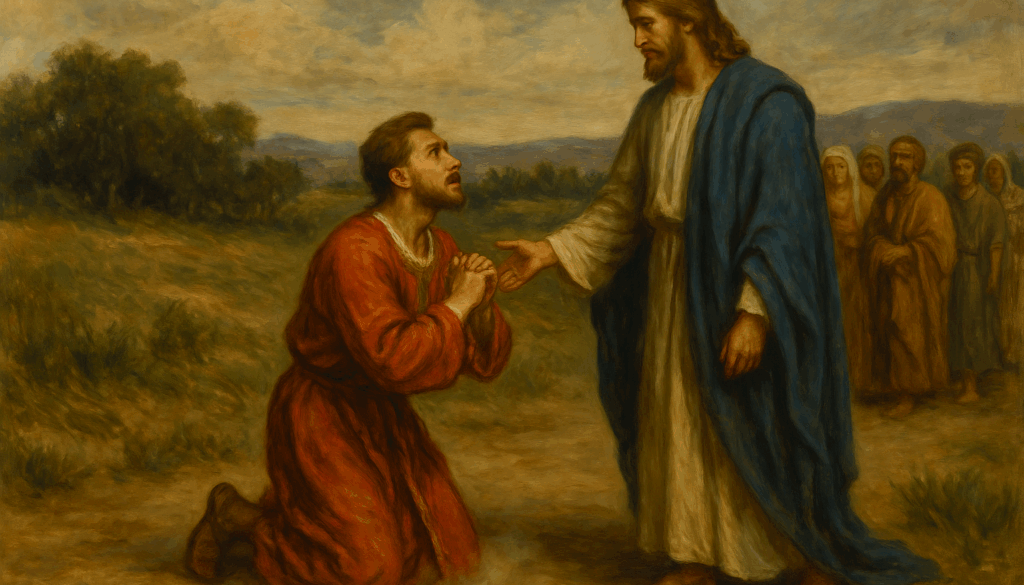
A wealthy young leader sprints into the dusty road.
Nobody saw this coming.
He falls to his knees.
He is sincere. He is devout.
He is restless.
The scene lasts only a handful of verses, yet it plays out like a dream:
symbol after symbol, echoing across centuries —
a soul approaching the threshold.
This is not just his story.
It is ours, whenever the mask begins to slip.
1. Unfolding the Encounter
Running and Kneeling
He runs. He kneels.
The dignity of position cracks under the pressure of longing.
This is the break in the persona — the socially approved mask.
Something deeper calls, and the ego rushes to meet it.
We call it urgency. Depth psychology calls it the Self.
“Good Teacher” — the Projection Rejected
He begins with flattery. Jesus returns the compliment like a mirror:
“Why do you call me good? No one is good but God.”
The hero-worship is dismantled.
The projection returned.
The journey inward begins with this:
Stop outsourcing your goodness.
“I’ve kept the commandments…” — Checklist Spirituality
He has followed the rules “since youth.”
He’s moral. Respectable.
But the hunger still gnaws.
This is the first half of life — strong ego, firm code, hollow centre.
Righteousness without encounter becomes performance.
And performance cannot save.
“Jesus looked at him and loved him.”
Before the invitation, before the challenge,
there is only a gaze.
Full of love.
Unconditional.
In therapy, we call it positive regard.
In IFS, we call it Self-energy.
In Jesus, we call it grace.
“One thing you lack…” — Three Verbs That Dismantle the Mask
Sell. Give. Follow.
Each verb slices into a different thread of attachment.
- Sell — detach from possession, protection, permanence.
- Give — release status, join the human circle of need.
- Follow — let go of doing, and be with.
This is the call to the second half of life.
Not to more effort, but to surrender.
Not to climb higher, but to become less — and freer.
“He went away sad.”
The word is λυπούμενος — not just sad, but grieving.
This is no mere disappointment. It is a soul pierced by truth.
The persona feels its mortality.
The self he built — disciplined, admired, in control — begins to crack.
But this grief is not shame.
It is holy sorrow — the ache that comes just before surrender.
Because something must be mourned
before it can be released.
2. The Inner Cast — The Soul’s Struggle at the Threshold
Every great story begins with a call.
This one begins on a dusty road —
where a young man, admired and accomplished,
kneels before the only One who cannot be flattered.
The Rich Young Ruler is not just a character —
he is the Hero at the edge of his known world,
standing before the Threshold.
But to cross it, something must die.
Persona — the mask of virtue, success, and spiritual credibility.
He had mastered the outer life: wealth, obedience, reputation.
In mythic terms, this is the first armor the hero wears —
shiny, impressive, but ultimately fragile.
The persona helps us belong.
But if we never take it off, we never come home.
Shadow — the hidden fear behind the smile.
It whispers: Without my roles, who am I?
This is the dragon at the threshold —
not evil, but unacknowledged pain.
In the story, the shadow is not named outright —
but it is revealed in the man’s refusal.
Shadow doesn’t confess. It protects.
Self (capital S) — the deep, eternal centre.
In the Hero’s Journey, it’s the treasure guarded by the dragon —
the true self, buried beneath persona and defended by fear.
Jesus doesn’t argue. He looks.
And in that gaze is the invitation home:
not to do more, but to become who you already are in the Father’s eyes.
Threshold Archetype — the mythic moment of decision.
The call is clear: “One thing you lack…”
Sell. Give. Follow.
These aren’t just moral demands — they’re symbolic steps:
Release the past. Join the human family. Step into mystery.
The ego tightens.
But this is the pattern: the Hero must die to be reborn.
Attachment Complex — the false kingdom.
His wealth wasn’t just stuff — it was his story.
And to lose it felt like soul-death.
When wealth, morality, and identity fuse,
they form a fragile crown that cannot survive the fire of Love.
This is the great risk of the spiritual path:
To be unmade… in order to be remade.
3. Walking It Out — Integration in Real Time
Inventory the Attachments
What roles, titles, virtues, or possessions do you cling to for identity?
Which one, if taken, would make you walk away in sorrow?
That’s your threshold.
Titrated Surrender
Take a small fast:
Give anonymously.
Turn off your metrics for a weekend.
Do something beautiful in secret.
Then watch what emotions arise.
That’s your shadow.
Cognitive Reframing (CBT)
Catch the thought:
“If I lose this, I’ll be nothing.”
Challenge it with lived evidence:
When have you been loved just for being?
Somatic Dialogue
Where in your body do you feel the grip?
Place a hand there. Breathe.
Imagine Jesus looking at you — not measuring, just loving.
Let your nervous system learn it’s safe to drop the mask.
Internal Family Systems (IFS)
Meet the Inner Ruler — the part that manages perfection.
Ask it: What are you protecting me from?
Then let it meet the part of you that longs to play, rest, trust.
Let them talk.
Ritual Act
Give something away.
Burn the token.
Mark the release with blessing, not shame.
Community Mirror
Don’t walk alone.
Let a few trusted souls hold your sorrow,
hold your joy,
hold your gaze —
when you can’t yet see yourself clearly.
4. A Third Ending — Midrash for the Modern Soul
Scripture leaves him in the dusk.
But perhaps that sadness was holy.
Perhaps later, under a quieter moon,
he remembered the eyes that loved him before he did anything right.
And maybe the next time,
he said yes.
The invitation remains:
Sell what owns you.
Give what isolates you.
Follow what frees you.
This is not the end of the self —
it is the beginning of becoming whole.
Begin again.
And again.
5. Epilogue: The Ruler Must Die for the King to Rise
He was not just rich.
He was not just young.
He was a ruler —
a man who had learned to master life through effort, virtue, and control.
He stood at the height of the first half of life.
And then he knelt.
But he was not ready to fall.
He longed for eternal life,
but still believed it could be earned —
secured by obedience, sealed by status.
What he met instead was the King.
And the King didn’t flatter him.
He loved him.
But love — real, holy love — does not coddle the ego.
It invites its death.
“One thing you lack…”
Not one more achievement, but one final surrender.
The undoing of the self you’ve built
so the Self you were born to become can rise.
This is the archetypal journey written in flesh and Spirit:
- The Hero must stop striving.
- The Inner Ruler must step off the throne.
- The False King must die
so the true King — Christ within you — can live.
This isn’t just about money.
It’s about whatever we rule over
to avoid being ruled by Love.
He walked away sad — not condemned,
but cracked open.
And sorrow, when blessed, becomes seed.
Perhaps next time,
he’ll return not running,
but ready.
Not to earn,
but to follow.