
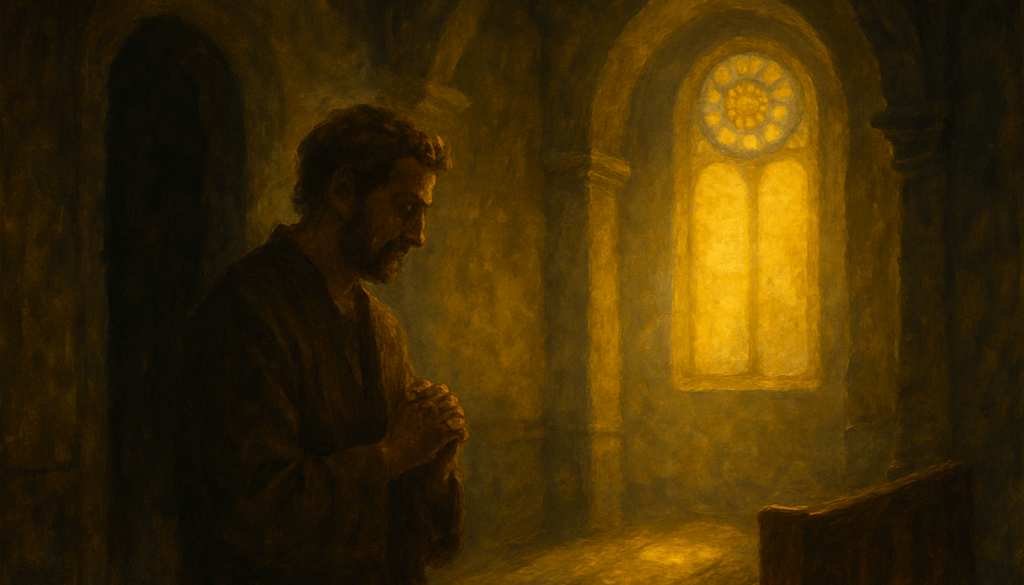
An Introduction to Christian Shadow Work: From Holy Pretence to Holy Presence
“You desire truth in the hidden heart; teach me wisdom in the secret places.” — Psalm 51 : 6
1 · Why Bother with “Shadow” at All?
We all carry two tales: the daylight story we curate and the midnight story that whispers when screens go dark. Scripture honours both. Light that cannot be overcome (John 1 : 5) and darkness that must be revealed (John 3 : 19‑21). Shadow work is simply the choice to let Christ’s lantern wander into rooms we’d rather keep locked.
Shadow is more than sin. It is:
- Wounds never grieved
- Strength we’re scared to wield
- Desires we buried under duty
- Dreams we dismissed as childish
What we refuse to face we drag like ghosts through prayer, marriage, and ministry. Shadow work asks: What if the gospel heals what you hide, not just forgives what you confess?
2 · Shadow in the Scriptures
Shadow work isn’t something imported from Jung—it’s woven into the fabric of Scripture. From Genesis to the Gospels, we see the human tendency to hide, deflect, or project—and we see God’s patient, illuminating response.
In Genesis 3, Adam and Eve reach for fig leaves and hide. God’s response? A question: “Where are you?”—an invitation to exposure, not condemnation.
In Psalm 139, David wrestles with mixed motives and unknown impulses. He doesn’t demand clarity from himself—he begs God for it: “Search me, O God, and know my heart…”
Matthew 7:3–5 shows Jesus confronting projection: pointing out the speck in another’s eye while ignoring the log in your own. He calls for inner honesty first—lumber-work, not blame.
In Luke 15, both the rebellious younger son and the self-righteous older brother represent different shadows. The Father runs to meet both—with the same invitation: Come feast.
And in John 4, Jesus meets a woman carrying secret shame. Once the truth surfaces, he offers her Living Water. No shame. Just presence.
Throughout Scripture, we don’t see repression or performance rewarded—we see honesty, exposure, and grace leading to transformation.
3 · A Working Definition
Christian shadow work is the Spirit‑led unveiling of the unacknowledged self—sinful, wounded, or untapped—so Christ can weave it into wholeness.
Three anchors keep the practice from drifting:
- Christ‑centric — Jesus is healer and interpreter of the depths.
- Scripture‑tested — The Word discerns motives (Heb 4 : 12‑13).
- Fruit‑examined — Love, joy, peace confirm real growth (Gal 5 : 22‑23).
4 · Why It Matters
- Ends projection — When I own my anger I stop crucifying others for it.
- Heals trauma — Named wounds can be tended; tended wounds become scars that testify.
- Frees calling — Gifts trapped behind fear can finally breathe.
- Deepens prayer — God meets the honest heart, not the edited one.
- Strengthens witness — Integrated saints radiate credibility: “Come, see a Man who told me everything I ever did.”
5 · A Five‑Step Starter Path
- Set the Scene
Find an uninterrupted hour. Light a candle if it steadies you. Pray Psalm 139 softly: “Search me… lead me.” - Spot the Trigger
Where did you over‑react this week? Jealousy at a friend’s promotion? Rage on the motorway? That hotspot is a doorway. - ABC Journaling
- Activating event (what happened)
- Beliefs & Body (thoughts + sensations)
- Consequences (feelings, actions)
Ask: Which part of me felt unseen or unsafe? Write without moralising.
- Invite Jesus into the Scene
Picture Him stepping inside that memory. Where are His eyes? What truth does He speak? Stay until a word of grace surfaces. - Share the Light
Don’t solo‑hike the depths. Bring a trusted friend, pastor, or therapist into the discovery. Light shared is light multiplied.
6 · Guard-Rails for the Descent
Shadow work is sacred—but it’s not without risks. When we turn inward, we need outer structure. Guard-rails help keep us tethered as we descend, not to restrict us, but to protect what is precious.
-
Scripture as plumb-line
If an insight contradicts the gospel, release it. Not every “deep truth” is a holy one. The Word grounds our exploration in reality—not fantasy.
-
Community as mirror
Isolation distorts. Fellowship refines vision. Honest community keeps us from navel-gazing or spiraling into abstraction.
-
Sacraments as anchor
Bread and cup remind us: salvation is a gift, not a self-improvement project. Shadow work must stay rooted in grace, not performance.
-
Professional ally
Some wounds are too tangled to unravel alone. Therapy is wisdom, not faithlessness. A good therapist is like a trail guide—there to walk beside you when the terrain gets steep.
-
Common sense and pace
The goal isn’t to dig everything up at once. Go slowly. Stay grounded in everyday life: cook, walk, laugh, sleep. Jung himself warned that shadow work must be gradual—and only undertaken when the ego is strong enough to withstand what it finds.
-
Spiritual discernment
Not every inner voice is divine. Practice distinguishing the Spirit’s whisper from the ego’s tricks or trauma’s echoes. Pray for clarity, not just content.
-
Embodiment practices
Stay connected to your body. Walk barefoot, breathe deeply, stretch, eat well. The body keeps you in the present—and shadow work without embodiment risks becoming dissociation dressed as depth.
Shadow work is holy ground—but it is still ground. You are not called to float. You are called to walk. These guard-rails keep your feet steady while grace does its deeper work beneath the surface.
7 · Tools for the Traveller
Not everyone approaches the inner life the same way. Some need structure, others need silence. Some want theology, others want a gentle nudge. Shadow work requires tools that meet you where you are—but don’t leave you there.
Here are a range of entry points:
-
Emotionally Healthy Spirituality by Peter Scazzero
A church-tested guide for those who want spiritual depth with emotional honesty. Especially helpful for leaders and long-time believers who’ve hit a wall.
-
Invitation to a Journey by M. Robert Mulholland
A thoughtful introduction to spiritual formation that respects your personality, wounds, and wiring. Great for thinkers, readers, and teachers.
-
The Pray-As-You-Go app
Scripture-based audio meditations, five to fifteen minutes long. Ideal for commuters, parents, or anyone needing grounding in a busy life.
-
The Daily Examen (Ignatian Practice)
A five-step reflection at the end of the day. Helps you spot where you felt life-giving flow—and where your shadow hijacked the moment.
-
Internal Family Systems (IFS) introduction videos
For those drawn to psychology and parts work. Explains how the “shadow” may actually be a cast of internal characters needing grace, not shame.
-
The Wisdom of the Enneagram by Don Riso & Russ Hudson
A powerful tool for naming your core fear, false self, and spiritual path. Best for self-reflective types who enjoy personality work.
-
Art journaling or expressive movement
Not everyone integrates through words. Drawing, dancing, or painting your emotional state can surface hidden layers without analysis.
-
Spiritual direction
A relationship built around deep listening. Unlike therapy, it’s not about fixing—it’s about becoming attuned to God’s movement in your real life.
-
For the Deep Diver: Jungian Tools and Sacred Depths
If you’re ready to explore the shadow with full intensity—and have a solid spiritual grounding—consider Carl Jung’s core writings, such as Modern Man in Search of a Soul or Aion. Pair this with care: Jung’s insights are profound but demand discernment. For a more accessible on-ramp, try Robert Johnson’s Owning Your Own Shadow, a short but potent Christian-friendly distillation. You might also explore dream work (writing and reflecting on dreams as soul-messages), active imagination (dialoguing with inner figures), or mythological study (reading Scripture symbolically, not just literally). These practices help make unconscious patterns visible—so they can be transformed in the light of Christ.
8 · Closing Words for the Descent
Christ kept His scars—even after resurrection. That should tell us something.
As you begin this inner work, don’t rush. Don’t go it alone. The deeper you dig, the more important it is to stay connected—to truth, to people, to the ground beneath your feet.
Let light in slowly. Let grace meet you where you are—not where you think you should be.
Some parts of you may shake when exposed. That’s normal. Keep going.
And when it gets dark, remember: the point isn’t to escape it. The point is to find the Presence that never left—even there.