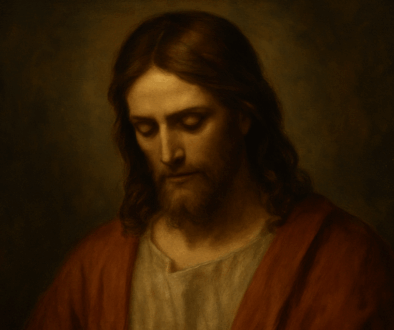

From Wound to Wholeness: Jesus and the Man with the Withered Hand
“Then He said to the man, ‘Stretch out your hand.’ And he stretched it out, and it was restored, as whole as the other.”
— Matthew 12:13
1 · A Public Drama of the Inner Life
The synagogue is crowded, the air brittle with gotcha energy. Rule-keepers who whisper in corners. Eyes scanning for error. Into this brittle calm walks Jesus, not as a rule-bound rabbi, but like a field surgeon entering triage.
“A man was there with a withered hand.” — Mark 3:2 (ESV)
The withered hand, once his power and tenderness, now dried up. A part of him gone silent. Some commentators imagine he kept it tucked inside his cloak—a plausible gesture in a culture that often read bodily defect as spiritual blemish
If so, he would have entered with only his “good” hand visible, shaking, reaching, performing normalcy. But Jesus doesn’t let the false self stand. He calls him out. In front of everyone.
It’s almost cruel, unless you’ve ever experienced what it means to be seen and invited out of hiding.
A neutral crowd? Unlikely. It’s looking for a scapegoat to preserve its illusion of holiness — check out René Girard.
Jesus disarms the mechanism by making Himself the lightning rod
2 · Why a Hand?
The hand is rich in symbolism—and neurobiology.
“The hands are the instruments of man’s intelligence.” — Maria Montessori
- It maps a disproportionately large swath of the motor cortex.
- In Jungian terms, it’s an emblem of conscious agency. To be withered is to have libido blocked—often through shame or grief.
- Mythic figures like Hephaestus, the lame smith-god, suggest that brokenness and creativity often live together.
- And in trauma science, learned non-use (see Edward Taub’s work) shows how limbs can be “mapped out” of the brain after injury or fear.
In other words, when our reach gets punished, we stop reaching. Then we forget how.
3 · When Safety Opens the Soul
“The nervous system is not healed by logic. It is healed by safety.” — Deb Dana (polyvagal expert)
Before theology can heal, the body must feel safe.
Psychologists and trauma therapists agree: no transformation happens without trust. Neuroscientist Dan Siegel calls this ventral-vagal attunement—that deep, embodied sense of “I’m safe now.” And Jesus offers it instantly.
He doesn’t lecture. He locks eyes. His tone is calm, His presence settled. His request—“Stretch out your hand”—is not a demand, but a reachable invitation. It speaks directly to the nervous system, not just the intellect.
The man, long trapped in shame and freeze, reads the cue. And against everything he’s learned about danger, rejection, and exposure—he stretches.
What looks like a miracle begins with co-regulation.
Jesus meets the body before the belief.
4 · The Inner Cast: A Drama of Parts
This scene unfolds in public—but it reflects a private, inner landscape we all carry.
In Internal Family Systems (IFS) terms, the Pharisees are Manager parts—rigid, rule-bound, trying to keep things orderly to avoid vulnerability.
Their accusatory tone—“Is it lawful…?”—is classic Firefighter energy, desperate to shut down discomfort by shifting blame or stoking conflict.
The withered hand? That’s the Exile—a once-vital part of the self now buried under shame, disuse, or trauma. Hidden, but still aching to rejoin the system.
“We try to exile the pain, but the pain holds the key to our wholeness.” — Richard Schwartz, founder of IFS
And Jesus—He stands as the Self, in IFS language: calm, curious, connected. Or in Jungian terms, He is the archetypal center, the unifying force that holds the opposites. Not the ego, but the wholeness behind the ego.
He doesn’t banish the Pharisees. He doesn’t argue with the Firefighters.
He sees the Exile.
He speaks to the wound, not the mask.
That’s how inner healing begins: when the true Self shows up—not to dominate or divide, but to integrate.
5 · The Mechanics of the Miracle
This isn’t sleight-of-hand—it’s soulwork in motion. A layered choreography of restoration:
1. Shame Called into the Open
In Mark’s telling, Jesus says, “Stand up in front of everyone.”
Exposure precedes healing. What is concealed cannot be cleansed.
The man steps forward. The part he’s hidden for years is now the center of the room—and the center of grace.
2. The Impossible Command
“Stretch out your hand.”
Not a plea for effort—but a paradox.
“Only the paradox comes anywhere near to comprehending the fullness of life.” — Carl Jung, Psychological Aspects of the Persona
Jung calls this the Transcendent Function: when the ego reaches its edge, something beyond it begins to stir (CW 8 §145).
The man doesn’t act alone—he consents, and grace does the rest.
3. Borrowed Will
The command contains the capacity.
In theological terms: potentia actualis—power made real.
Grace doesn’t bypass the will; it ignites it.
4. Restored to Symmetry
“And it was restored, as whole as the other.”
Not just healed—balanced.
In Jungian language, the inferior function—the neglected, unconscious mode—comes online.
Integration begins when the body, the psyche, and the spirit all recognize the Exile as kin.
5. Sabbath Re-Framed
The Pharisees demand rule adherence.
Jesus replies with a single piercing question: “Wouldn’t you rescue a sheep?”
He redefines Sabbath—not as rest from movement, but as restoration into fullness.
6 · A Somatic Layer
In polyvagal language, we could say Jesus re-engages the man’s dorsal-vagal freeze—that deep shutdown state where the body plays dead to survive.
His nervous system, long curled around shame, begins to thaw.
Blood flows. Breath returns. Muscle remembers.
The body, once a place of hiding, becomes a place of healing.
“You don’t talk trauma out of a body that’s still bracing for impact.” — Resmaa Menakem, My Grandmother’s Hands
Modern trauma science confirms what ancient traditions always intuited:
True healing must pass through the body.
Talk can begin it. Insight can guide it.
But wholeness must be felt—trembled into, exhaled into, stretched into.
If you’re in any doubt, read The Body Keeps the Score by Bessel van der Kolk.
Try this: Mirror the story.
Sit quietly. Breathe low into the belly.
Then slowly—deliberately—extend your arm as if waking it from a long sleep.
Notice tingles, tremors, resistance.
Let it come.
Then whisper, as if to your own Exile:
Stretch out…
7 · The Wound Is the Source of Wholeness
We all carry a withered hand.
A part of us—creative, tender, giving—once reached outward but was betrayed, shamed, or ignored. And so we learned to fold it inward, to hide it behind routines and rationalizations. We adapt. We achieve. We participate in the world only with the strong hand while concealing the one that aches.
“What is in the way is the way.” — Tara Brach
Nelson Mandela, after 27 years of unjust imprisonment, did not emerge embittered. He emerged whole—and somehow larger.
It was precisely his long confinement, his wound, that became the crucible of his becoming.
The prison stripped away pretense, burned through bitterness, and forged in him a deeper wisdom—one that could carry not just his pain, but his people’s.
He didn’t just survive; he transfigured.
Mandela is said to have recited William Ernest Henley’s Invictus from his cell—a poem written by a man who lost his leg but refused to let his soul wither:
Beyond this place of wrath and tears
Looms but the Horror of the shade,
And yet the menace of the years
Finds, and shall find me, unafraid.
His wound did not diminish his legacy—it became its foundation.
To stretch out the wounded part is to refuse to stay defined by fear.
Even Paul, scarred by persecution and physical weakness, writes in 2 Corinthians 12:9:
“I will boast all the more gladly about my weaknesses, so that Christ’s power may rest on me.”
In this Sabbath healing, the man’s hand becomes “as whole as the other.” Not merely functional—but symmetrical, integrated. The very part he may have hated is now restored to right relationship with the rest of him. In Jungian terms, the inferior function has come online. In human terms, the broken limb has remembered how to give.
“The wound is the place where the light enters you.” — Rumi
Wholeness is not strength without wound.
Wholeness is strength that includes the wound.
8 · Integration Prompts
- Trace Your Hands.
On one, list strengths you overuse. On the other, list strengths you’ve suppressed. Pray for balance. - Audit Your Inner Sabbath Laws.
What unconscious rules do you live by? “Never be needy”? “Don’t slow down”? Which rules protect—and which imprison? - Paradox Practice.
Choose a small, “impossible” act—speak up, rest, dance. Do it for 2 minutes a day. Watch for flickers of new capacity. - Rescue the Sheep.
Next time your inner critic shames your weakness, ask: “Wouldn’t you lift a sheep from a pit?”
Then lift that part of you.
9 · Final Words
When the Holy speaks to the place that cannot move,
that word carries sinew in its breath.
May the part of you you’ve kept hidden begin to stir.
May the rules that guarded you loosen their grip.
May your two hands—
the hand of work
and the hand of wonder—
clasp again in sacred symmetry.
Let the wound extend.
Let the grace restore.