The Truth We Run From, the God We Can’t See
The condition of sin doesn’t always show up as some dramatic rebellion.
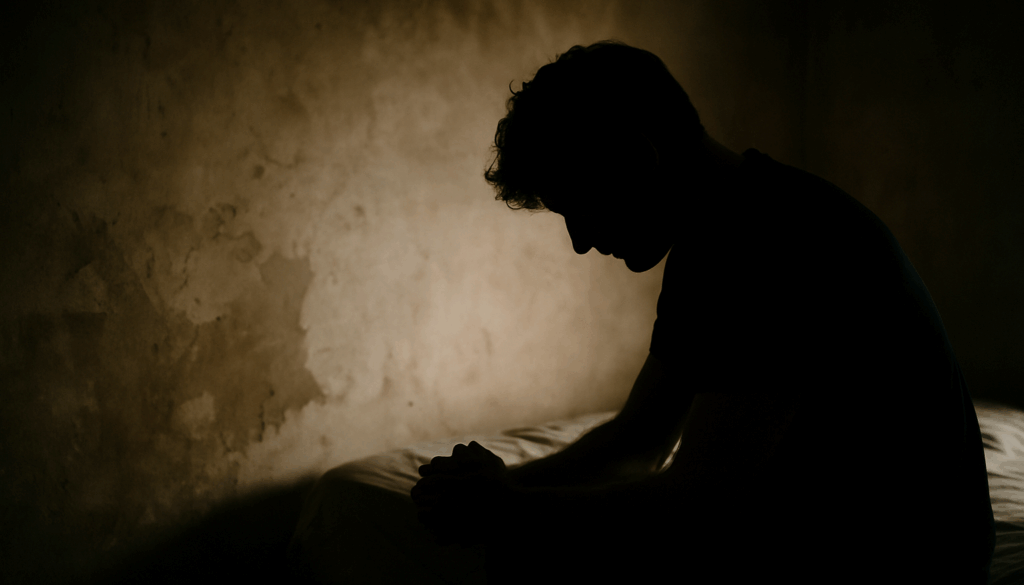
Most days, it just feels like this:
worthless, ugly, shameful, and utterly hopeless.
And that feeling — not the theology, not the doctrine, but the raw sensation of it — is often the most real experience of life.
A kind of ache that hovers beneath everything.
I don’t feel those things constantly anymore — not in the sharp way I used to.
But I still recognize the pattern:
The aching nostalgia for something I can’t name.
The anxiety about a future I can’t control.
The pressure to “be present,” to “be grateful,” to “be better.”
And the deep, soul-weariness of trying to be — instead of simply being.
It’s like I’m trapped in a maze with no exit —
every path looping back into itself,
every doorway promising freedom but leading to another dead end.
…Then I reread Romans.
Paul, in classic Paul fashion, moves quickly to the solution — to the hope, the grace, the rescue.
Don’t we all love that?
But just before that, I stumbled on something that really resonated — something raw, honest, and oddly comforting:
“We’ve compiled this long and sorry record as sinners (both us and them) and proved that we are utterly incapable of living the glorious lives God wills for us…”— Romans 3:22–23 (MSG)
And that was the moment it landed:
This ache isn’t just mine.
I’m not broken in some uniquely defective way.
I’m just finally feeling what everyone else is carrying — even if no one’s saying it out loud.
And then I stumbled across Heidegger’s phrase:
Being-unto-death.
It’s something called an Ontological condition.
That means that this is reality as best as we can grasp it.
That’s what that ache has been feeling. Facing death all the time.
Facing my limits everyday.
A truly hopeless condition.
And it get’s even stranger.
This is according to Heidegger, the best case scenario.
There is much worse.
And it’s called fallenness.
Fallenness
The Fall.
Theologians have coined the term for centuries —
ever since the heartbreak of Eden.
We intuit Eden —
we carry a deep sense that something is missing,
that something ought to be whole, but isn’t.
And yet we can’t remember it.
We can’t access it.
We can’t name it clearly.
It’s like homesickness for a place we’ve never been.
So by that idea, the best case scenario we have —
in this post-Eden world —
is the state of Being-unto-death.
It’s Bambi hearing the gunshot.
Simba nuzzling his father’s lifeless body.
A child seeing their parent cry for the first time —
and realizing they’re not invincible.
The moment the myth of safety dies.
That’s Being-unto-death in its most visceral form.
Not abstract philosophy —
but the lived knowledge that the world is no longer whole.
And in the absence of grace,
that awareness becomes a kind of cold clarity —
a place we can’t return from.
It’s the ultimate heartbreak:
You can’t fix the ontological.
You can’t undo trauma.
You can’t rewrite the past.
And this reality — this rupture —
creates a condition in the human soul.
Fallenness.
Not just a theological label,
but a felt experience.
It’s the way we live disconnected from ourselves.
It’s the addiction we reach for to numb the ache.
It’s the anxiety that takes over and calls itself vigilance.
It’s the endless scrolling, performing, pretending.
Fallenness is what happens after the myth of safety dies.
It’s the false self we construct to survive the truth.
And when I look at it through other lenses —
theology, psychology, culture, even Buddhism —
I see the same pattern everywhere.
This isn’t just a personal ache.
It’s the human condition, writ large.
The Ache We Pretend Not to Carry
We don’t speak about it much.
Not honestly.
“The wages of sin is death.”— Romans 6:23
But death isn’t polite conversation.
Especially in the modern Western world —
we don’t talk about it.
We barely grieve it.
Instead, we talk about stress.
Burnout. Overwhelm.
We post motivational quotes about “living in the moment.”
We talk about therapy, mindset, manifestation.
But we don’t talk about death.
And we never talk about this:
Not just eventual death —
but a living death.
A death of connection.
Of meaning.
Of soul.
Paul names it plainly:
“You were dead in trespasses and sins, following the course of this world…”— Ephesians 2:1
It’s paradoxical.
To follow the world’s way is, in a sense, to already be dead.
Because you’re not really alive.
Not in the way your soul was meant to be.
That’s what Paul is saying:
You can be breathing — and still be buried.
You can be moving forward — and still be lost.
It’s not just that we do wrong things.
It’s that we’ve become entangled in a way of being that is against life.
Sin is all over the Bible.
But reducing sin to “bad behaviour” misses the depth beneath.
As Paul Tillich put it:
“Sin is separation. To be in the state of sin is to be in the state of separation.”
We are orphans.
Estranged from God.
From Eden.
From ourselves.
And death — both literal and living — looms.
It’s the ultimate tragedy.
And it plays out in our lives every single day.
The Vision We Lose When We Refuse to See
Beneath it all — the hurrying, the busyness, the toxic positivity,
the smiling face hiding the aching heart — is a deeper truth:
We are not okay.
Not just because life is hard —
but because we are estranged.
But the tragedy doesn’t end there.
It takes a final, cruel turn.
Avoiding the cold, hard facts of separation and death
doesn’t save us.
It deepens the fracture.
Avoidance doesn’t protect us —
it divides us further.
In trying not to feel the separation,
we become even more separated.
It sounds impossible. Paradoxical.
But how could it be otherwise?
What makes you think your wilful blindness to death
doesn’t blur everything else you see?
Your avoidance of suffering becomes avoidance of feeling anything at all.
Your demand to “stay positive” hollows joy into a shell.
Your refusal to grieve numbs your capacity to love.
Fallenness is not our inherited state.
That’s Being-unto-Death —
the ache of finitude, the awareness that we are dust, and to dust we shall return.
Fallenness is what happens when we refuse to face that truth.
When we numb it.
Deny it.
Spiritualize it.
Distract ourselves from it with noise and performance and control.
It’s not the ache itself that breaks us.
It’s our flight from the ache.
Our refusal to be real with it.
To grieve it.
To accept it.
Neon Gods
It is in Fallenness that we bury reality —
and in doing so, bury ourselves.
And in that state, we try to build a life.
We perform.
We hustle.
We curate.
“And the people bowed and prayed to the neon god they made.” —Simon and Garfunkel, The Sound of Silence
We adopt ideologies to explain the ache.
We cling to habits and addictions to soothe it.
We use religion to control it.
We use relationships to escape it.
It all begins to mirror the Bible’s description of idolatry:
“Claiming to be wise, they became fools, and exchanged the glory of the immortal God for images…”—Romans 1:22–23
All of it becomes a kind of spiritual play-acting —
an attempt to live
without ever truly facing
the truth.
And We All Know It
We see it in the scrolling.
We see it in the avoidance.
We see it in the addictions.
We see it in the quiet disconnection of everyday life —
the way people smile but don’t look you in the eye.
We are beings walking toward death —
and we cannot admit it.
False Reality, False Self
To be clear: the separation isn’t just out there — universal, cosmic, Edenic.
As if that weren’t enough.
It’s in here.
It’s in the self.
It’s in every one of us.
The part that loses reality becomes lost.
Every time you avoid the truth,
a new self is born —
not in freedom,
but in fear.
A self shaped by what it hides from.
Thomas Merton called this the false self:
“The self that wants only to exist outside the reach of God’s will and love…the self that exists only in response to social compulsions.”— New Seeds of Contemplation
To not feel the ache, we build false selves.
And we start believing they’re real.
The temptation is always there.
We are wired to avoid pain.
But pain doesn’t disappear when avoided —
it just goes underground.
It becomes unconscious.
Carl Jung named this buried part the shadow:
“The thing a person has no wish to be.”— Psychological Aspects of the Persona
But denial doesn’t save us.
We don’t escape the shadow by ignoring it —
we become haunted by it.
We project it onto others.
We perform a false wholeness we can’t sustain.
And in time,
we become exhausted actors
on a stage we didn’t choose.
This is the tragedy:
The soul knows the difference.
Sitting With It All
I’m not ending this with a resolution.
In the spirit of things, I feel it’s better to let it sit.
This post isn’t about hope.
Not yet.
It’s about seeing.
Heidegger insisted that being-unto-death is not a problem to solve,
but a condition to face —
something to lean into, not run from.
We must acknowledge it.
Own it.
Take responsibility for it.
To flee from death is to flee from the truth of who we are.
But to turn and face it — soberly, clearly — is to become free.
“Only the authentic being-toward-death unveils the possibility of being one’s ownmost self.”— Being and Time, §53
And yet, it’s not enough to name the ache.
We have to feel it.
Let it in — not as an idea, but as a visceral truth.
The despair.
The hopelessness.
The weight of futility.
They must be allowed to speak.
To avoid that
is to avoid the divine.
Because until we stop performing — even for ourselves —
and let the ache burn,
it won’t transform us.
It will just keep hiding under everything we do.
Paradoxically, it’s only when we see the cold, hard truth
that it stops owning us.
“For when I am weak, then I am strong.” — 2 Corinthians 12:10
Naming it is the beginning.
But experiencing it — unflinchingly —
letting the sorrow and hollowness run their course:
That’s where true strength begins.